
A wise advisor, someone I admire and respect, once said to me “Strategy is What Happens, not what’s Supposed to Happen”. What Has Happened to our offices is, perhaps, just such an example.
In 2020 we made the decision to close our small London office, amidst the drama of the pandemic and lockdowns. This week we have said a final goodbye to our head office in Melton, Suffolk.
Riverside House has been our home for just 5 years, 2 of which have been lost to the pandemic. But we have always had our head office in Melton since 2004, so this is a big change.
We have opted to make working from our own homes our default mode, with flexible hours to boot, but we are aware that this will have consequences, so we see this as an evolving story.
The abruptness of the pandemic jarred so many businesses into adopting, at scale, remote working practices that have been in place for years. In Infotex, as in many businesses, we had already been working for a long time remotely with clients and staff across the world, on Hangout, Teams, Zoom and Skype, with all of the benefits.
Scaling this up to become the default taught us about new positives. For our staff who have always worked remotely from “the office”, having everyone on the same level has resulted in a new closeness within the business. Our daily chats mean that all of us see and hear more of each other than we used to, and our teamwork has improved through the flexibility of being able to make up teams so flexibly (although we tend not to use Teams, preferring Google Meet for its immediacy).
Having overall responsibility for the business, I feel more connected to all of our team of 25 than I ever have. Maybe that’s a damning indictment of how I was doing things before! Or maybe I am deluding myself. Certainly, this sense of connection has made me eager to find the ways and means to spend more time actually together. So far, we have had three 2-day “gatherings”, where the whole company works in one location. These have all been enjoyable, and constructive and important for our business. Now that we no longer have our building, we are free to roam. Our next gathering, in June, will be in Portsmouth. This is a welcome relief to our minority “Staff in the South”, who are relieved not to have to journey to Suffolk this time. It will no doubt invoke a nautical theme, and plans are afoot to visit the historic dockyard.
In the meantime, like so many other businesses, we are free to meet with one another and our clients in a variety of locations, many of them regulars. Serviced offices and workspaces offer the ideal answer for providing us with stimulating and enjoyable working environments when needed. For some of us, having somewhere to go is beneficial and needed, so this option always remains available to us all. But not being constrained by a rigid structure is an important step forward and feels like a step forward.
Propelled by events, we are following a new strategic direction, which is modern, flexible and resilient, and fills us with confidence. But it wasn’t supposed to happen.

The practice of logging into services, also known as authenticating to them, has been around since the 1960’s and in many ways not much has changed in the last half-century which, given the pace of development within IT, is quite staggering.
Even today for most purposes you will simply be asked for a email address and a password. Is it right for that to still be the case?
The problem is that email addresses are relatively easy to find or guess, and people are not very good at generating strong, random passwords. Indeed, all too often a password is little more than a word – perhaps your cat or dog’s name. When lists of passwords actually in use are revealed they all too often have entries like “123456”, “qwerty” & “password” filling the top slots.
Back in the 1960’s the volume and value of data protected by these passwords was relatively low, where it is now quite possible (albeit bad practice) to use the same password across multiple sites. Many of these sites are not administered to the same security standards that we expect from our banks and government bodies, so logins stolen from an insecure website can be used on more secure systems.
So, how are companies increasing security on logins to their sites? There is a computer science theory that a “factor” for authentication must be one of the below:
With a standard login, only knowledge is required, but by adding additional ‘factors’ security is increased. One of the first forms of 2-factor authentication (2FA) was when, in the early 2000’s, credit cards went from a simple swipe to “chip & pin” – thus they changed from a single factor of card possession to 2-factor – possession of the card & knowledge of the PIN.
You may have noticed that more recently a similar change was made when purchasing online via a card as you are now sent a text message to add Possession to the existing Knowledge of the card number.
This is a perfect example of where 2 Factor Authentication (2FA) becomes Multi-Factor Authentication (MFA) as there are scenarios today where all 5 factors are actively being utilised.
In the background the card providers are also doing location checks, i.e. if you purchase an in-store item in London and Manchester within a half an hour, the latter will generally be declined as banks know that it is highly unlikely you could have travelled that distance. This has been refined to the extent that I personally had an online banking transaction blocked a few weeks ago because I used a different broadband connection/device combination that had not been seen on my account before despite using 2 other valid factors to log in.
Using text messages is a very simple and ubiquitous way to provide a 2nd factor, however, security weaknesses in the text message system have reduced the security industry’s recommendation of this.
With the prevalence of smartphones you may now find yourself being asked to use an app to generate the multi-digit one time code, that when combined with the date and time generates a series of numbers that changes every minute as a Time based One Time Passcode (TOTP) as a way of proving Possession of your phone.
Google Authenticator was the first popular app to embody this very simple yet elegant technology that doesn’t even require the phone to be connected to the web (aside from downloading the app initially).
There are other competitors such as Microsoft Authenticator, LastPass Authenticator and some banking apps which work the opposite way in that the website instead sends a challenge to the app on your phone asking for confirmation that you are logging in and requiring your fingerprint to complete the login. This sends a confirmation back to the website, and you are effectively using 3 factors to complete the login: the username/password combination as Knowledge; phone as Possession and the fingerprint as Inherent.
The question that I’m sure many will still ask is whether all this extra effort is really justified?
In 2019 Microsoft research concluded that 2-factor authentication would prevent 99.9% of the over 300 million daily automated login attacks on their platform.
Google similarly concluded that their use of phone-based authentication prevented “100% of automated bots, 96% of bulk phishing attacks, and 76% of targeted attacks”
In the case of systems like Microsoft Authenticator and Google 2-step verification, having your phone popping up asking you to verify your login unexpectedly also provides early warning that someone has just breached your password and that you need to reset it – suffice to say if it pops up unexpectedly never, ever, approve it!
2-factor and multifactor logins are good techniques to improve security which you should be employing wherever practical (for some certifications such as Cyber Essentials it can even be a requirement) but this should not replace the need for your actual password to be strong (i.e. containing upper & lower case letters, numbers and punctuation) and unique as it still remains your first form of defence. You also need to ensure that you keep these additional factors current so when you upgrade your phone ensure to migrate any authenticator apps, if you are going overseas consider whether any services you will need have been locked to your country.
Most website administration areas don’t yet require 2-factor or multifactor logins, but this is gradually changing. WordPress has plugins that can add this capability, so if you would like it added to your site for additional peace of mind please speak with us.
So when you next log in to a site ask yourself whether you can add 2FA to your existing account. You might be surprised, Google, Microsoft, LinkedIn, Facebook, Twitter all offer 2-factor login free of charge.
It has been a year since we launched the website for local wedding venue Houchins. And what a year it has been!
The UK Weddings Task Force has estimated there will be a staggering 350,000 weddings in 2022. That’s almost 960 weddings per day in the UK! There is an estimated £14.7bn direct spend on weddings every year and more often than not, a huge chunk of the wedding budget will be spent on the venue and services tied to that.
Houchins, an Essex based wedding venue is an elegant wedding venue with stylish grade 2* listed farmhouse accommodation. Located in north Essex it has a rich history dating back to the 17th century. Houchins came to us to redesign and deliver a new website that would provide sustainable income whilst also ensuring their customers got a good feel for their style and excellent service. This was a strategic decision following the creation of the original site we had created several years earlier.
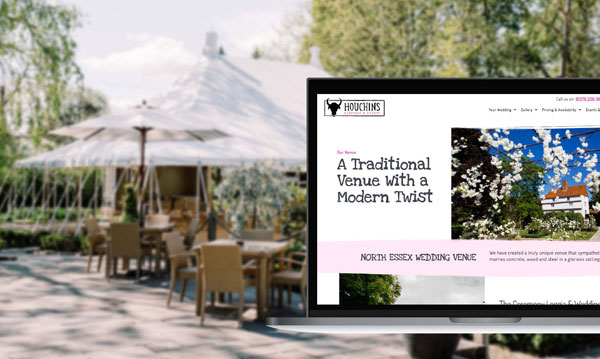
They host ceremonies and formal receptions for 150 guests and evening parties up to 180, with a range of entertainment areas on site, including the house itself – all of which have been beautifully designed to create a rustic-meets-traditional aesthetic. When approaching wedding couples, it is key to find a balance between delivering the core information (such as costs, terms and conditions etc) while elevating the experience the couple will have on their big day.
A critical part of our brief was to keep the couples and their special day at the heart of the design, using imagery and customer-centric site navigation to make the point.
A total of 320,000 weddings have been postponed since March 2020
Source: www.weddingstaskforce.co.uk
“During COVID, it was sensible to pause marketing activity, instead, time invested in learning more about customers needs and enriching the online experience for them when our venue was able to open again.”
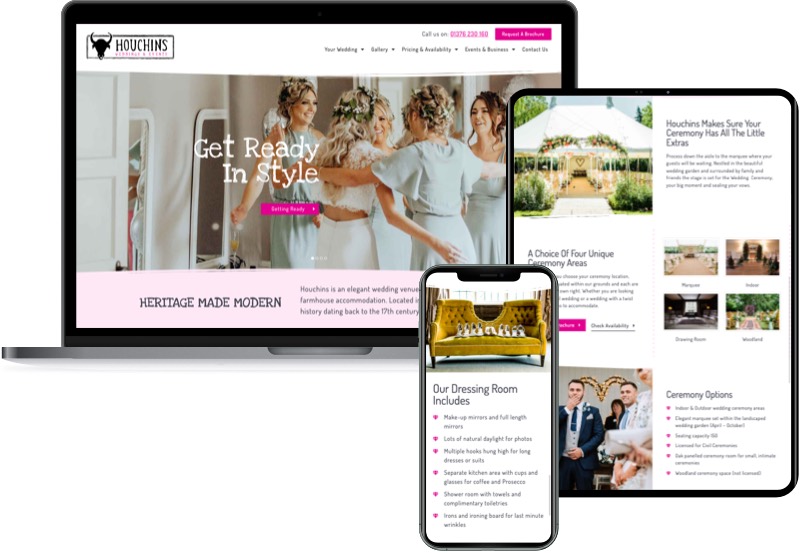
Houchins have demonstrated remarkable resilience over what has been a very difficult 12 months (for all in their industry) but despite this, they have grown from strength to strength. We are delighted to have played a role in their success, and decided to look back on what we have been able to achieve with them.
Create an engaging website to capture leads, and the hearts of brides in the UK. We knew from previous experience that much of the search would occur online. As a start, we explored booking data and looked at the associated postcodes to make sensible decisions around design and potential marketing opportunities for the site.
Kris Parker, Project Manager for this re-design says “Our focus when building this new WordPress site was on mobile accessibility to suit the majority of users who use handheld devices, so clear calls to action to relevant pages are provided throughout.”
We were lucky to have access to some excellent photography which helped us boost the pathway to enquiry we needed to establish for the Houchins team.
“Infotex has been a key part in developing Houchins into a significant player in the Essex wedding market.” Adam Dixon-Smith – Owner
Our customer support team were able to identify key general trends in the marketplace and we saw this mirrored in the analysis from the Houchins website. Through this research we saw:
Keeping this in mind, we have continued to support the site and we were able to report an increase in user engagement, even before an increase in traffic as the result of improvements to the site.
Key improvements we have seen specifically in:
As part of our analysis to demonstrate site effectiveness, we ranked activity (based on pageview) across the site to build a picture for the client of the customer journey and sequence of questions the customer has in their head as they navigate. This allows them and us to better understand the behaviour of their potential customers and through this we can steer more positive and deeper engagement leading to higher conversion rates.
Infotex identified a huge uplift in visitors via mobile compared with traffic in 2019. The team at Houchins need to be able to make sure their content is accessible and engaging via the website for mobile visits as 67% of traffic can be attributed to this.
Through our rank analysis we can prioritise improvements to support and propel lead generating visitors.
We continue to support their marketing with Google Ads, Facebook Ads and other digital marketing activities, but we are more excited to see what 2022 has in store for the amazing team at Houchins and their lovely couples.
Visit: www.houchins.co.uk
It ensures our systems are up to date, secure and fit for purpose meaning our clients can rest assured that they are working with a business that is confident in its digital security. Plus, we have the hands-on knowledge to guide their security measures when we develop their websites and systems.
By having a clear picture of our organisation’s cyber security level, we can remain vigilant and keep ourselves ahead of any risk. Further securing our position as a reliable and trusted provider, particularly in the more heavily regulated industries and strengthening our position to further support larger government-backed organisations.
We signed up for Cyber Essentials Plus as part of our ambition to be transparent, accountable and authentically proactive for higher standards of security and support – meaning our clients can be confident they are in a safe pair of hands.
Our Cyber Essentials and Cyber Essentials Plus reviews were overseen by URM Consulting Services.
Why PLUS is different – self-assessment and independent review of our position
We decided to work to achieve the higher assessment level – Cyber Essentials Plus which ‘To achieve Cyber Essentials Plus, you must already be certified to Cyber Essentials. Gaining the extra qualification will also involve a technical expert conducting an on-site or remote audit on your IT systems, including a representative set of user devices, all Internet gateways and all servers with services accessible to unauthenticated Internet users. “
Working with Lauren and the team has allowed us to elevate our security measures and we can step confidently forward knowing we are in the best position to support ourselves and our customers.
We signed up for Cyber Essentials Plus as part of our ambition to be transparent, accountable and authentically proactive for higher standards of security and support – meaning our clients can be confident they are in a safe pair of hands.
URM’S assessor commented, “Infotex has a strong set of controls in place and an exemplary patching process where the organisation is applying the most up-to-date operating systems and system software which provides both security and stability.”
Richard Howlett, a Lead Developer at Infotex said ‘We are very proud of achieving Cyber Essentials Plus certification. Infotex has made some significant investments in its cyber security infrastructure and this external validation provides a clear demonstration to our clients and partners of our commitment to protecting the organisation from cyber-related attacks.”
Understanding the bigger picture, and the impact COVID and working from home measures have had in the background of businesses.
“The government reports that as many as two in five UK firms have experienced cyber attacks in the last year.”
Throughout the assessment process, we learned that many businesses have experienced issues similar to ours.
Martin Jones, who leads the Cyber Essentials Plus initiative commented “During the COVID-19 pandemic, a significant number of organisations have struggled to keep up-to-date with the latest patch cycles and security updates as the patching systems were kept on the local network. With many, if not all, machines being remote, the patches could not be applied effectively. Some organisations have relied on end-users to apply patches manually, but this relies on the users’ technical aptitude and conscientiousness.”
A significant portion of the effort surrounding mobilising our staff to effectively work from home was the proactive management of our IT kit by our talented and experienced staff members.
This was a key concern for our team, as our stability and security mindfulness directly impacts our clients and their business. We decided to boost our online resilience by taking the proactive steps to work with the team at URM Consulting Services to thoroughly assess our position, and take any necessary corrective steps.
“Infotex managed to keep their applications up-to-date despite the challenges being faced. They achieved this by applying updates remotely and by keeping the number of applications they use to a minimum hence reducing the effort required.”
If you would like to learn more about what we did, and how we can support your business – give us a call. Every project starts with a chat.

Infotex’s primary base of WordPress sites are not affected by this but do check your external systems.
First developed in 1995, Java is a popular programming language that you may be using without even knowing it! All Android phones are based on the Android Runtime which is itself a derivative of Java.
Java is a very structured language known by developers for embodying Object-Oriented-Programming methods and being platform agnostic, i.e. code written in Java will run equally well on Windows, Apple’s MacOS, Android phones and a plethora of esoteric platforms.
At one point it was commonplace to embed Java “applets” into web pages, however due to the power of Java this was found to be a very risky practice and modern browsers do not permit this.
In computing most systems output status updates for diagnostic purposes, some systems make these available to users while others hide them from public scrutiny by writing to logs thus allowing developers to understand what went on when something failed.
Log4J is a utility overseen by the well known Apache Foundation which is coded in Java and is designed to process log requests either from Java applications or third parties and can apply a raft of highly complex rules to understand when a status update is routine vs. critical in nature.
Because it is so powerful yet easy to configure, this has been used in a wide variety of purposes, both bundled with Java systems and deployed to process logs from other systems (one example might be to take web server logs and promptly raise a support ticket when certain classes of error occur).
There is a highly publicised bug in Log4j from version 2.0-beta9 – 2.14.1 which is technically known as CVE-2021-44228 but more commonly by the nickname “Log4Shell”.
This was announced on 9th Dec 2021 before its maintainers were even aware of it, it appears attackers had been taking advantage of it for at least a week prior and as such is given the “Zero-day” moniker and scores the highest possible severity rating of 10/10.
Basically, on systems not configured with formatMsgNoLookups, the vulnerability allowed an attacker to create a request which would be processed by Java’s Naming & Directory Interface (JNDI) and would cause the server to make an external request and potentially execute code provided by a third-party attacker. That’s about as bad as things can get when a system is intended to process logs that anyone can initiate in web scenarios.
There are already reports of attackers using this bug to run bitcoin miners earning money for the attacker on afflicted servers.
Fixes were provided by log4j’s maintainers in version 2.15 with a subsequent release to more fully disable potential attack vectors in 2.16.
The US Cybersecurity and Infrastructure Security Agency (CISA) estimates that there are hundreds of millions of devices that are (or were) vulnerable to Log4Shell.
Infotex’s core online platform is WordPress which runs on a PHP platform and none of our log processors run log4j, nor do our client servers have Java installed.
As such our primary base of client sites are not affected.
Since the news of this vulnerability broke on Friday our team reached out to a number of specialist suppliers who offer services (e.g. custom search facilities) to specific clients which could be impacted and have received confirmation from those suppliers that fixes are being, or have already been deployed.
We have also evaluated a number of tools that we use internally (Log4j is also in use on some desktop utilities although the window of opportunity for an attacker there is minute as those systems are not available for attack online) and we have installed updates where applicable for these tools.
We frequently recommend Cloudflare as a security & performance option to clients and it is worth noting that any websites with Cloudflare’s WAF deployed were protected from attack soon after news of this issue broke as they enabled an emergency firewall rule to block potential exploits.
If your website is managed and hosted by Infotex then the likelihood is that you do not need to take any action. If you have websites hosted by anyone else, then you will need to check with those respective hosts to clarify their position. You should also check that you do not have any vulnerable installations of Log4j on your desktop or devices within your business, as it can be utilised in desktop programs.
There are several resources online trying to pull together software vendors statements clarifying whether any updates are needed etc.
One such list can be found at: https://gist.github.com/SwitHak/b66db3a06c2955a9cb71a8718970c592
Keeping your computers and website safe is a constantly evolving challenge and requires co-operation from all parties and this demonstrates the need to know who provides what and ensure that they are managing those systems effectively.
The winter of 2021 is going to be a particularly tough one for countless families across the country. Deciding to support Home-Start UK by taking on a mud run was one of the easiest decisions Infotex has made.
Back in October, the Infotex Home-Start team took part in the gruelling Whole Hog challenge. The eight-strong team completed a cross country run complete with 30-mud based obstacles, all in the name of charity.
Home-Start has been there to support thousands of families across the UK who have struggled with the difficulties of isolation, disability, mental health issues, bereavement, poverty, financial difficulties and multiple births, among others.
Thanks to the support of our family and friends, the Infotex Home-Start team managed to raise more than £2,500 to help the charity continue its much-needed work.
At 18 weeks into her second pregnancy, mum-of-three Katherine was told her daughter had Down’s syndrome. Three weeks later, she was told her daughter had a number of holes in her heart.
Her baby arrived at 35 weeks and spent her first month in hospital. That’s when Katherine’s health visitor referred her to Home-Start.
“Looking back, I was surviving on pure adrenaline. Everything else was falling apart, but I had my blinkers on – I could just deal with what was in front of me – everything else would have to wait. That included the house,” Katherine, 35, said.
“My health visitors referred me to Home-Start so I could get a little bit more help at home. There was always so much to do in the flat and I could feel the pressure building on me. To have someone come in and remove that pressure gave us the space we needed to focus on my daughter’s health needs. This was especially important because the gruelling feeding programme continued once we got home.”

The volunteer helped four hours a week with laundry and cleaning and stayed for a chat.
She added: “When you are in such an intensive situation, it’s really refreshing to talk to someone who isn’t emotionally involved.
“Our volunteer helped to ensure our eldest always had clean clothes to go to school in. Things that may have been missed with everything else that was going on. Looking back, I don’t know how we coped. But I do know that it would have been so much worse without Home-Start.”
Katherine’s daughter spent a further four months in hospital for heart surgery and the volunteer frequently called to ask if there was anything she could do to help. She also supported the family when the baby was discharged.
Katherine and her partner then fell pregnant with their third child and again, a Home-Start volunteer was there like clockwork.
“When lockdown happened and took away this support it was devastating,” Katherine explained. “Our third baby was just six months old. I also had a one-year-old, was home schooling a six-year-old, in a one-bedroom flat, and living with the after pain of symphysis pubis dysfunction which left me hardly able to move some days. The only aspect of lockdown I didn’t actually mind was not seeing people. I actually liked that part of it. My upbringing was hard. I don’t have happy memories of adults. “
She added: “During lockdown, Home-Start was very proactive in sending us activity packs to do. They’d often call to ask if we needed anything. My eldest got really into painting rocks after Home-Start dropped some off along with some paint.
“You can’t adequately convey the impact of Home-Start. Everyone has problems and everyone needs a helping hand, but Home-Start provides a hand, an ear and a heart. I’m so grateful to have Home-Start in our lives.”
For more about Home-Start and how you can help, visit www.home-start.org.uk
With Stripe’s Payment Link system you can quickly create a page for customers to safely provide their contact details and purchase. This could be used for selling tickets to a one-off event (with a fixed value), gift vouchers, or even for recurring subscription payments. As the name suggests, you provide a specific link to your customer which relates to a certain product. They go to that page, hosted on Stripe’s secure servers, and enter their details.
Customer’s can even pay via Apple Pay or Google Pay, making it a super quick way to checkout. Not only that, Stripe’s clear pricing model of 1.4% + 20p a transaction with no monthly fees makes it very competitive.
We’ve created a demo Stripe Payment Link example here, with the majority of features enabled. Note that the system doesn’t work like a shopping basket, you can only buy the product the link has been created for, so its not a substitute for an e-commerce store.
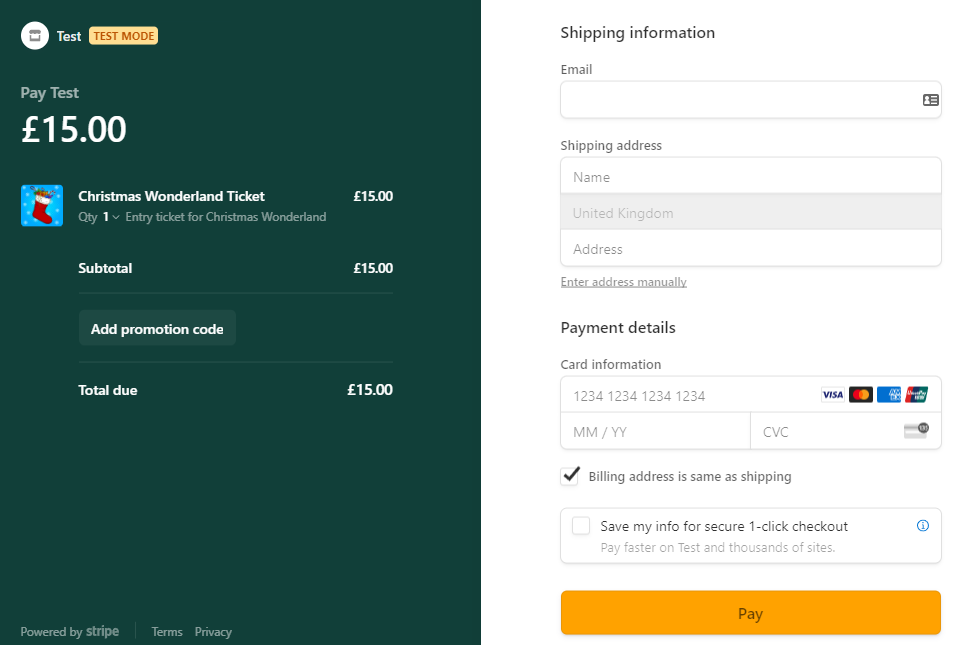
Firstly, go to stripe.com and register for an account if you haven’t got one already. At this point you can choose to use the ‘test mode’ to see if this solution will work for you, or if you’re happy to dive in select Activate Account.
Go to the Payments section of the Dashboard, and select Payment Links in the left hand navigation.
Select New from the top right to create your first link.
You’ll need to create a new “Product” to sell. This could be for a service or subscription you offer, or for a physical product. Click into the “Find or add a product” box then “Add a Product”.
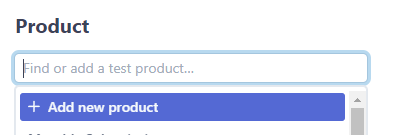
In the popup complete the name of the product and the price. You can select either a One Time price, or one that’s recurring. Within the recurring options you can set the frequency of the recurrence, from daily up to yearly. Set up the pricing carefully as once you’ve created it you will be unable to edit it.
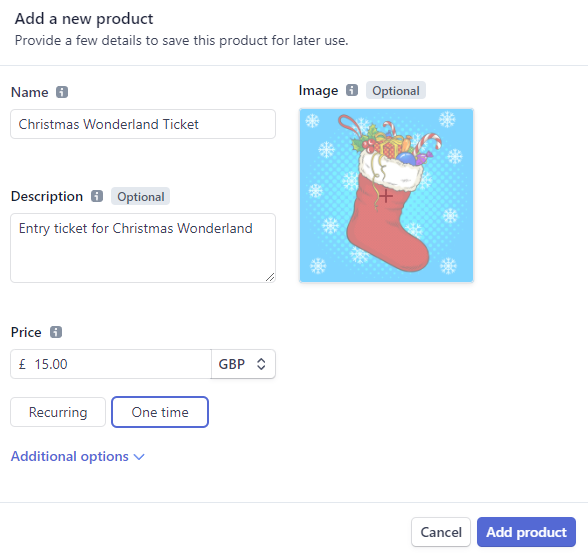
If you wish, upload an optional photo, this will show on the payment page so can be a visual clue to a customer they are purchasing the correct time. Images should be a jpg or PNG file smaller than 2mb.
Select Add Product to create the product.
Once you’ve created your product you’ll see a preview of the payment page on the right hand side.
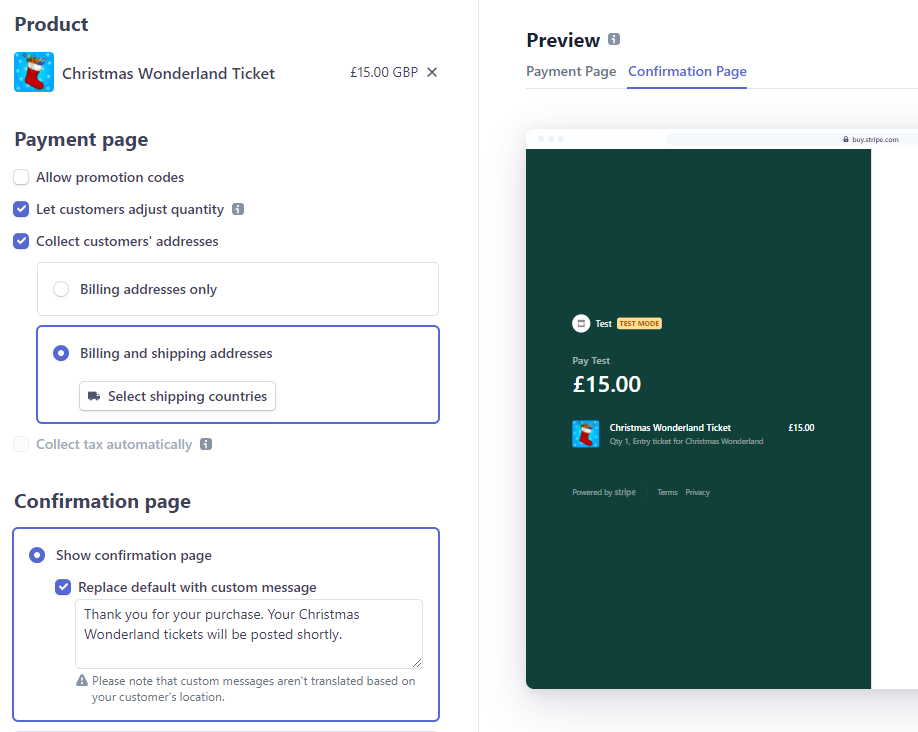
There are a variety of settings you can customise for your payment link:
Use of promotion codes – Enabling this allows customers to use discount coupons. Coupons can be created as either a percentage discount, or a fixed value amount, and can be limited to a set period of time or total number of times it can be redeemed. These are created on the main Stripe dashboard under Products : Coupons.
Adjust the quantity they can purchase – This allows a user to purchase multiple of the product you are offering.
Collect customer’s addresses – Allows a customer to provide a billing and shipping address. If you select Shipping you can select which countries you wish to ship to.
Collect tax automatically – You’ll have to do a bit more configuration to get this working, detailing your business details and item origins, but once done it’ll auto calculate tax rates.
Confirmation Page – You can either show the default Stripe confirmation page with a custom message, or redirect users to a page on your own website. You can toggle the preview of this at the top right.
Once you’re happy with you page click the Create Link button at the top right. You’ll be presented with an overview of what you’ve just set, and the all important link button at the top, so you can view your new page.
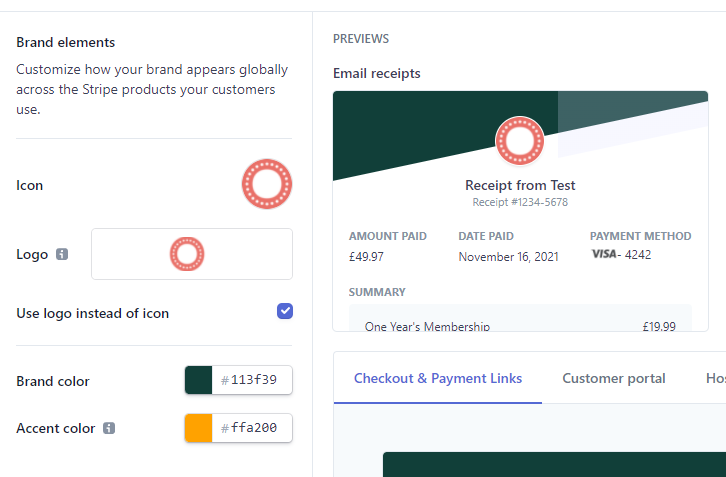
You will likely want your page styled to match your brand, although the default styling is usable out of the box. To style your page go to the Cog icon at the top right, and select Branding. In here you can assign a logo, and brand and accent colours. These will then be applied to your payment page and email receipts.
That’s it! Copy the link you created earlier and share it via email or on social media posts.
It’s great that you’ve been able to take a payment, but most companies will want to do something more with the data once an order has been place. Stripe integrates with Zapier, a hugely flexible system that links different platforms together.
A popular integration is Google Sheets, so any order placed will appear as a new row. This means you can add additional information to them, such as tracking order status or delivery tracking codes.
For further information on linking Zapier to Stripe see their help page.
We have collaborated with Suffolk GP Federation to design and deliver a brand new system, designed exclusively for Podiatrists in order to:
This past week, the team travelled to Liverpool to officially bring the new self referral platform to market at the Royal College of Podiatry conference, held at the legendary ACC Liverpool venue. This gave us an excellent opportunity to engage with potential buyers, and users to further strengthen the system.
The College of Podiatry conference is the largest of its kind in Europe and we showcased our exciting new system, designed to improve outcomes and support the patient pathway as well as deliver practical help for clinicians.
While there, we offered live demonstrations of the platform, both the administrative back end including how clinicians could tailor the system to their specific particular practice and also the pathway through which the patient is guided.
“This system enables those with the greatest medical need to access podiatrists with the right skillset to give the best care for that patient. All the while reducing the number of wasted hours, improving patient outcomes and giving the patient agency over their own care pathway. This makes life easier for GPs, Podiatrists and most importantly patients.
The brilliance is in how adaptable this is. The different elements can be customised to then suit the needs of the service. During the pandemic Suffolk GP Fed had to drastically change how we handled our podiatry caseload. Despite everything we were still in a position to give advice and support to new patients, and focus our resources on saving the limbs of those most in need all thanks to our referral system.”
Philip Holloway – Podiatrist / Suffolk GP Federation
We also ran a prize draw in which entrants had to guess the right answer to a footie question! Overall, it was an excellent show and the podiatry community are a fantastic bunch to be around.
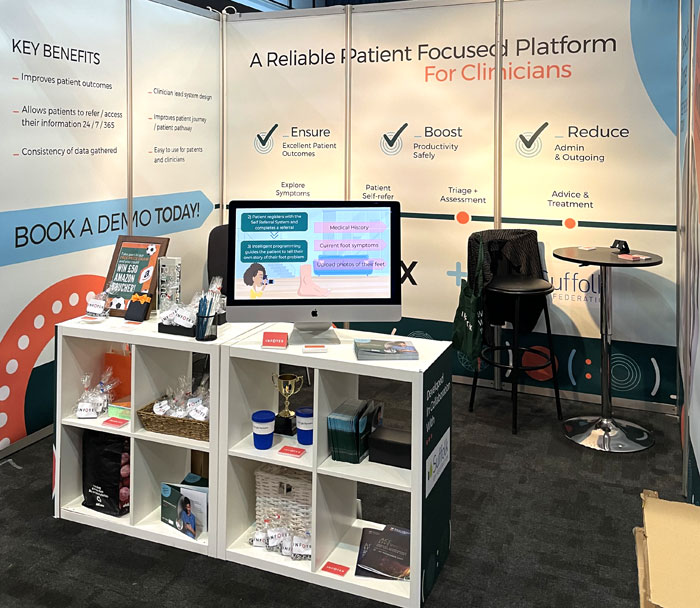
Though created specifically for Suffolk GP Federation and podiatrists, the bones of the system offer a very solid and exceptionally efficient pathway for any customer or patient type via full end to end onboarding, assessment, appointment scheduling and appropriate advice.
It is a clinician lead system design, and can be adjusted exactly as required. All outcomes are based on carefully planned question sets which you can alter to support your clients and practice behaviours.
Please contact the team to book a demo.
It is extraordinary how much human beings like being together. We are social animals and we do well to remember it. As we have all braved our way through the past 18 months of lockdowns and working from home, much has been written and said about the positives and the move towards a new normal.
In Infotex, everyone has certainly embraced the opportunities presented when working from home, to be able to do our jobs whilst also enjoying less time travelling and more flexibility in our working days. We have been focussing on these positives, and in doing so I wonder if we have almost been experiencing a mild form of “Stockholm Syndrome”, whereby we were deluding ourselves that we are better off held in captivity.

With the knowledge that we were going to be allowed to emerge in the Autumn, as the Covid restrictions finally abated over the summer, and having entered a team to take part in a running event for charity, we took the opportunity to block out the diary across 7-10th October, and I was pleased that we were able to bring the whole company together for two days in our Riverside House Suffolk HQ. And I was amazed at how enjoyable it was to simply be together again. Perhaps after 18 months of daily video communication, I shouldn’t have been amazed. It was almost like meeting a whole bunch of people I am used to seeing on TV, the excitement of meeting the cast.

We spent the two days holding overdue discussions about our business – technical and commercial strategies were explored, productivity workshops held, along with team discussions about how we can work more effectively together as an integrated unit.
We continue to discuss across the business the pros and cons of working-from-home. As we approach 2022 we are carrying out a thorough review of our working patterns to make these as effective as possible for the future. We all agreed on the importance of meeting up in person, and we are now committed to regular sessions like this at least 4 times a year, whilst we also remain committed to supporting the work-from-home infrastructure which has also proved to be so durable and effective.
So will we keep Riverside House? This is currently not certain, but we can be sure that we do continue to see value in having our own “HQ” in Suffolk and a physical presence around which we can all congregate. Meanwhile, we have had a reassuring reminder that we still have our “home from home” in Suffolk, and another happy memory of time spent there….

On Sunday 10th October the Infotex Home-Start team completed The Suffolk Whole Hog, a gruelling 5 miles (8km) run, complete with 30 mud-based obstacles. Or, an enjoyable romp through beautiful countryside in fine weather – depending on your view.
There is still time to support our fantastic cause, Home-Start’s work is never-ending, to donate click here.
The Home-Start UK team was mostly people from Suffolk-based Internet experts Infotex, which has become an enthusiastic supporter of the charity. Matt Adlem, Alice ‘ALICE’ Mottram, Chloe Agar, Katie Robinson, Ant Agar and James Fulford. The last 3 being veterans of the 2013 Whole Hog 8 years prior. They were joined by friends and partners Alex Jenkinson and Shaun Bailey to boost the competitive spirit.

As the team started to arrive at the venue, pre-race nerves were quickly overtaken by blind optimism and enthusiasm to crack on with the race. Although not all the team had clicked that they were in a race. It was quickly agreed “not to stick together”, so it was every man or woman for themselves – the race was on!
Then there was the obligatory, over-energetic race warm-up, which got everyone suitably hyped, if exhausted! Then they were off….

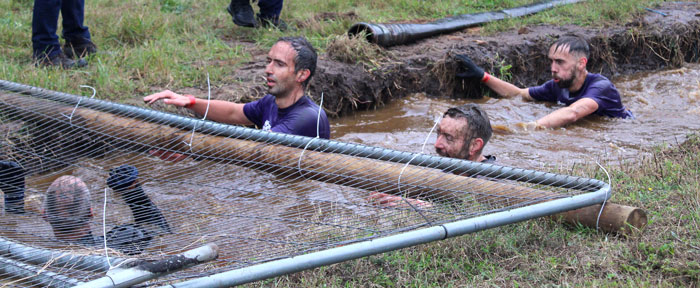
It did not take long before the whole team was soaked and covered in mud. Less than 5 minutes. This was because the race organisers, used to herding cattle, channelled the runners directly into a sort of giant sheep dip that you might expect to find on Clarkson’s Farm, and proceeded to pump pond water over them from a great height. After the dip, young-blooded Matt sprinted ahead, with James and Shaun frantically chasing his tail, while the rest of squad squelched after them.
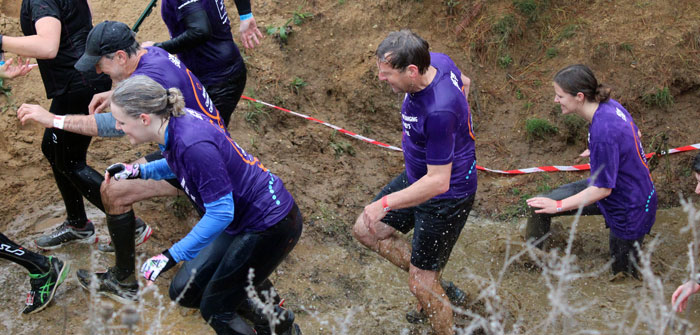
Matt, James and Shaun formed a pack, ducking and weaving their way through to the front of the crowd. Alice and her partner Alex led a second group, scooping up father-daughter duo Ant and Chloe Agar who had been enjoying the beautiful Wantisden Valley at their own pace, allowing themselves enough time at each obstacle to ponder the questionable smell and the proximity of the mud to the pigs they had been admiring, so they needed to be kicked into action! Almost exactly midway between these two groupings ran Katie, Infotex’s ever-reliable Production Manager moving with consistency and speed, keeping the two groups connected so that it was still one team.
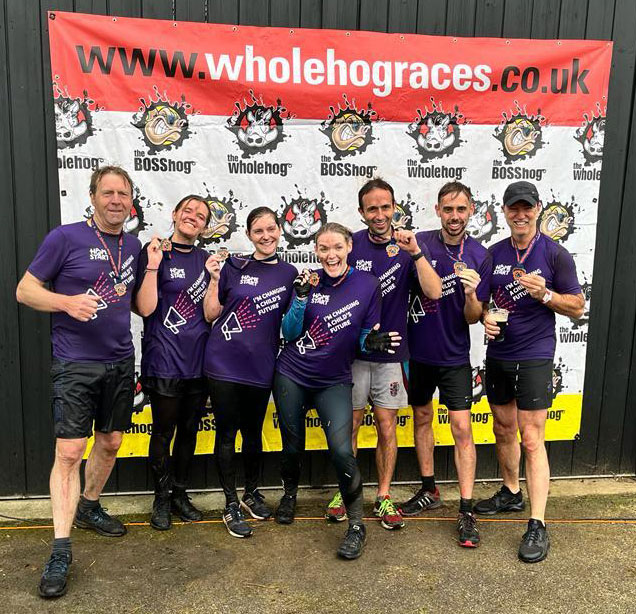
All of the team did fantastically, significantly thrashing the 2+ hours time set 8 years prior (with much fresher younger legs). James (53.33), Matthew (54.35) and Shaun (54.45) came in an impressive 3rd, 4th and 5th from their group of around 300 competitors.
Katie even more impressively (1:07:20) finished shortly after and took gold as first woman to finish.
The rest of the team were not too far behind these fine athletes and crossed the finish as one less than 15 minutes after Katie, placing Home-Start Infotex in the top 30.
Too many children miss out on the most important years of their life because of family crises. Home-Start is always there for families who are reaching breaking point because of isolation, bereavement, illness, poverty, and more.
The winter of 2021 is going to be another particularly tough one for countless families across the country who are lacking the support they need post-pandemic, against a background of rising costs when the £20 Universal Credit top-up has been withdrawn.

The difficulties of isolation, the effects of postnatal illness, disability or mental health issues, bereavement, multiple births, and poverty or financial difficulties are just some of the challenges faced by families in the UK. No matter who you are, a difficult life-changing event can happen to anyone.
Home-Start supports creating more stable, loving, and fun childhoods, working with parents and children together, spending time at home with families, giving children what they need for their first day at school, helping families access the services they need, supporting young mothers, and creating groups for parents to get together and talk, and much more. Their approach is individual, expert, confidential, and compassionate, powered by an amazing 58,000 volunteers across the country, each of whom is giving more generously than we can all know.
At the time of writing, we are inching closer to our target to raise £2,500, which we are determined to exceed by as much as possible.
To donate to this fantastic charity go to justgiving.com/fundraising/infotex
For more about Home-Start see their website home-start.org.uk
A special thanks also goes to Airborne Fit for helping us with our training, and sponsoring the event.

After careful consideration, we have decided that the Infotex look needed a bit of a make-over to pave the way into the next chapter of its service to website production. We didn’t want a total re-brand – our core values and missions remain the same – but we wanted to look carefully at where we are now as a business, and whether our brand-look really looked like us anymore…
The process we went through to create a design and feel that felt suited to us required the same kind of introspection we ask of our clients when we are designing a website. We reassessed our purpose, captured into values, brand pillars, audience understanding, and business purpose to connect each brand expression decision to a reason. We could never manage this alone, and I am deeply grateful to my good friend and expert brand consultant Kevin Bolton (see www.ybrand.co.uk) for his patience and persistence throughout this process, together with the creative team he leads.

Essentially, we felt it was time to assess our own true colours, and discovered there was no longer a reason for our red-and-white colour scheme, which has served its purpose. Though in the past the bold, brave red suited us well, we felt it was time to acknowledge who we are today and our renewed focus on making websites work for our clients.
So, welcome to our new Infotex livery, which retains our trusted logo but sets it in the context of a new and sophisticated green-based colour scheme, which is now reflected on our website.
We hope that our existing clients and friends, many of whom we have known for more than a decade, feel reassured we are the same Infotex as always, but one which they and our new clients can also recognise is committed to making progress and continuous improvements to the way we deliver services.

Home-Start is a local community network of trained volunteers and expert support helping families with young children through their challenging times. If you’d like to donate in support of the charity Home-Start, visit our Just Giving page.
Our MD, Ant, is the reason we all heard about Home-Start in the first place, so really we have him to blame for our aching legs… or to thank for the money that has been raised so far. Either way, here’s how he’s feeling about the upcoming race:
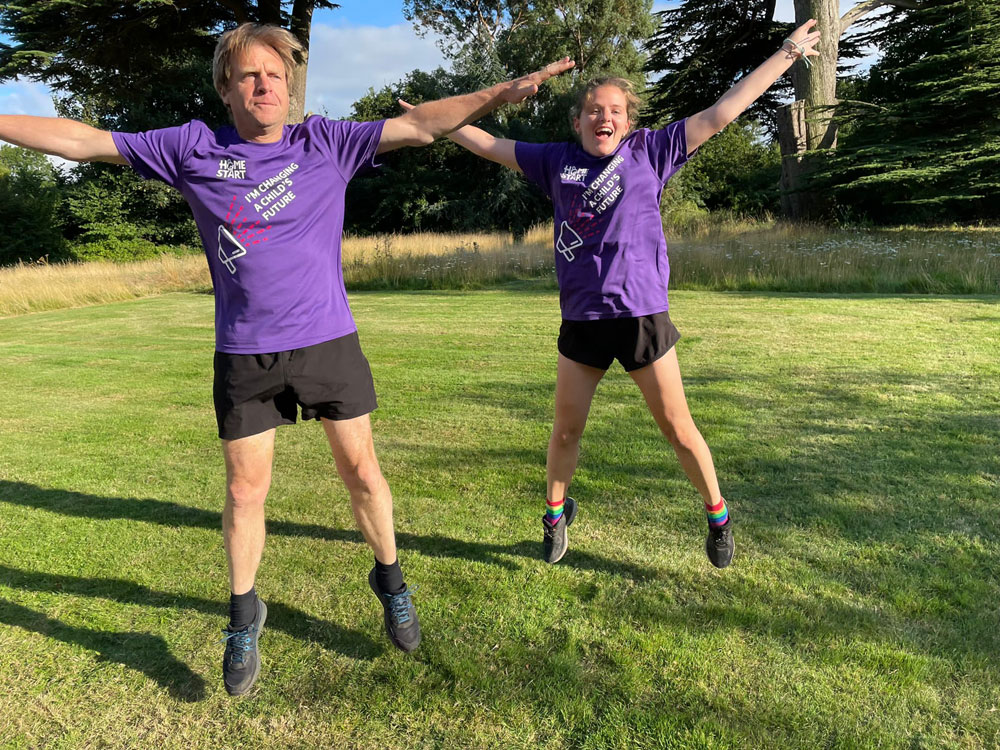
“Infotex took part in the Whole Hog once before, 7 years ago now when I was 50… now I’m closer to 60, and I’m feeling it! This summer I started training by introducing a 5k run into my routine, from my home to Sizewell beach, knowing I could get to the end with the promise of a swim at the end. Then I attended Luke’s Airborne Fit classes in Woodbridge, which were amazing. At first I didn’t even know what a squat was, but now I’m a lot better… I think.
I am so impressed by the work Home-Start does so I really want to encourage everyone to support us if they can – even the smallest donation is appreciated. In the final days before the event, I still need to keep at it, so I am going to focus now on why I am doing this…for Home-Start, who do so much, with so little. They make such effective use of Every £1 they get.”

“As a mother myself, Home-Start really connected with me on an emotional level. The team are so passionate about helping families and I felt compelled to support them in any way that I could – a muddy 5 miles was the answer! To get ready for this challenge I have participated in the circuit training sessions hosted by Airborne Fit, which have certainly been the toughest part of my training. My upper body strength is my weakest area so I think some of the strength-based obstacles will be my biggest challenge. I am already a regular runner but I’ve increased my mileage to help build my stamina and I was even able to persuade my family to join me in a colour run event during the summer!”
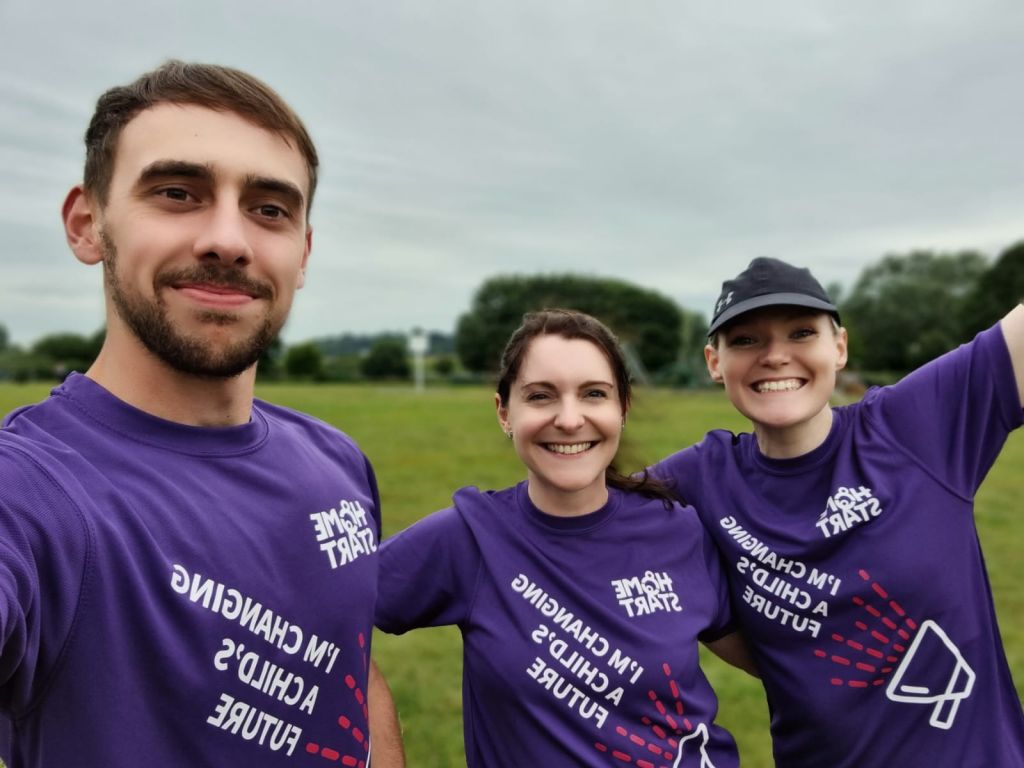
“In amongst the busy-ness of work, summer holiday, and the rest, sticking to a training plan has been tricky! I found that the things that worked to keep my fitness up best for me have been walking and football sessions, plus lots of running in the recent weeks. The greatest sense of accomplishment I got was from doing Luke’s Airborne Fit class, because he pushed us in the most encouraging way.”
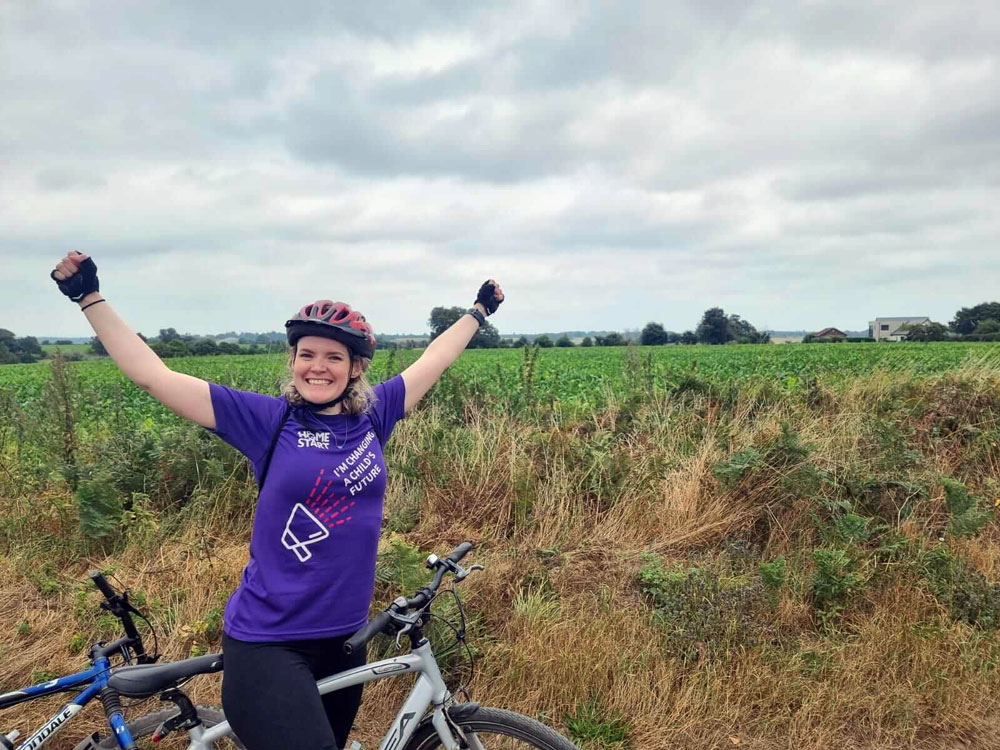
“When I signed up to do the Whole Hog I was feeling pretty fit and healthy and confident I’d be able to at least make it round. All it took was a couple of weekends away to throw me off my exercise regime and I quickly fell off the wagon. Fast forward several months and I’m finally getting my fitness back. I’ve been back doing a 5k run on weekdays plus a 30min full body workout. Whilst at the weekends I’ve been trying to fit in some more leisurely (fun) exercise like this bike ride with friends (to the Maybush pub and back…does it still count if you drink a couple of pints?). And I climbed 3 mountains whilst away in Wales last week – so hopefully my fitness level is up!”

“It has been very moving working with Home-Start and all the great work their very passionate team do. They really do make every donation no matter what size go a long way.
As far as the Whole Hog is concerned… I approached it with a level of arrogance and optimism that I now regret! At the time of signing up, we were all in lockdown and I had turned into a very boring fitness geek, turning my living room into an ’80s like’ home gym… I didn’t have ankle warmers and a leotard, but I wasn’t far off! Since then, I have been lucky enough to have a summer consumed by my own wedding, honeymoon and a successful sailing season, but my fitness is all but gone! Nonetheless, I really look forward to doing my bit for Home Start and their great work… even if I do end up crawling the course or requiring a lift from one of my teammates!
For those of you that need more incentive to donate to Home Start, I promise photos of my initial arrogance reduced to humility as I struggle around the obstacles and mud of the whole hog!”

“It sounds obvious, but I’m really realising what a difference every donation makes to my motivation to get fit for the Whole Hog. I really don’t like running, and I definitely don’t like press ups and sit ups and all those things… so it means a lot when someone donates and I think, OK, now I better do more training because this might actually be worth it! I lose motivation quickly, but every donation helps, and I am definitely much fitter now. I have run to places in London I wouldn’t usually visit otherwise (the river is my favourite). But I’m still pretty nervous about doing the race
We know we can’t make a huge difference, because we’re not a huge business, but even £5 can go toward helping a family. If you can donate even the smallest amount, please go to our Just Giving page!
To everyone who has realised how important Home-Start is and already donated, we are so grateful for your support. You’re the ones getting us over the finish line, thank you!



Discover how our team can help you on your journey.
Talk to us today