
I’m at my desk, in “the TV room” at home, which I have claimed in a military manoeuvre. It has undergone an upgrade over the weekend from “where I work when at home” to “the office”.
I click the “Google Hangout” popup alert and in a few seconds I am presented with a striking array of familiar faces. We have 22 people working in Infotex. Not all are full time, but today everyone is on the call. I can see a wall of anxiety on my desktop and I am not sure what to say to it. So at first I waffle on about how this is all unprecedented and we must brace ourselves for a commercial shock. But unlike many managers out there, I am able to turn to something more concretely positive: the silver linings at our disposal as an online business able to continue to operate more or less unaffected. How there is an opportunity for us to show leadership and courage, and to advance our online services in new ways, as the internet is now about to come to the fore.
We start to have a general chat. James picks up the theme and adds that it’s as if we just pressed fast forward on the things we have all believed in for years – the remarkable ability of the Internet empowering individuals and organisations to communicate and collaborate in ways that are so much more effective than ever seen before. We observe that the very meeting we are all having now is, well, comfortable and extraordinary in its quality. A reassuring facility in uncertain times.
This concept hits me with a force – that in a world which has suddenly become utterly unpredictable, we need to create some new certainties. The handrails and toe holds of life are about routine and certainty. I tell the team boldly “right we will meet here online every day at 9am for 15 mins for a catchup and general chat about things, then let’s take things one day at a time”. I do this as I sense everyone, me included, is going to need a new structure.
After three days of 9am catch ups, I start to meet resistance. Everyone is facing multiple challenges at the start of each day, with numerous Hangouts, Zooms and Meets, plus lots of production operations to get through. “Let’s try meeting at lunch time from tomorrow onwards”, I suggest on the day 3 catch up. There is then a typical Infotex discussion – friendly but firm, with plenty of opinion and sense of humour – about when lunchtime is. ‘Turns out some go for lunch as early as 12, and some as late as 2. This is not as disorganised as it sounds, it’s all about making sure we have people available all of the time for our clients when they need us. “Right”, I say, determined not to be outmanoeuvred, “we’ll have our catch ups at 11-45 daily – no one can say it’s too early, and no one can say they’re off for lunch”. And so it begins.
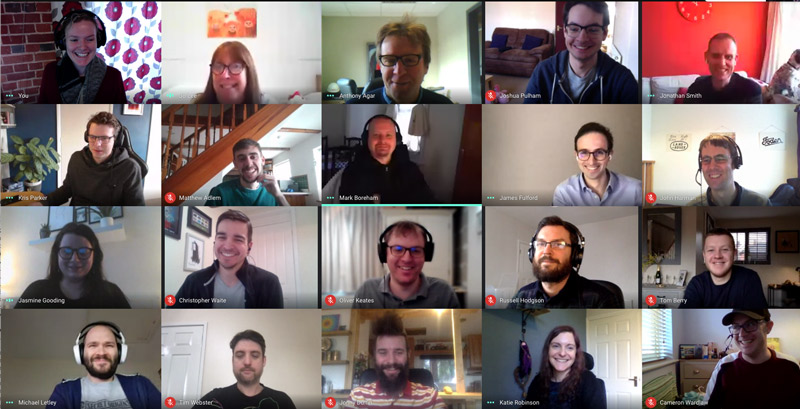
Lockdown continues and like thousands of small businesses all over the country we are now experts at working from home. We have had the Company Catchup at 11:45 every working day since March 23rd. The team has worked hard throughout to support our many clients with updates to their websites, as they all adapt to their changed worlds. Some clients have been exceptionally busy, with online sales many times greater than ever seen before. This produces challenges all round – one client, for example, quickly ran out of the small bags they use to sell to consumers, as their flour business was mostly selling to trade in large bags. Another client had to adapt their shops to become pick-and-pack centres and had streams of demand from customers wanting deep freezes and more audio visual equipment. Many of our clients had to shut down and just needed us to update all their messaging to tell customers about their new arrangements.
Like our clients, we are emerging from the mist and thinking about future plans and what will be the new normal. Already we know that we are never going back to the way we were before March. So how do we want to organise ourselves in the future, in a post-Covid world? We decide it’s time we did a survey, so Katie polls the team. She asks them to talk from a personal perspective (what they want for themselves) and from the company’s (what they think is best for the company’s future). The results, perhaps unsurprisingly, reveal how none of us can yet see very clearly into the future… but they do also show a distinct preference for working from home.
Meanwhile we make the office “Covid Secure”, although it remains mostly empty, and we offer our unused space to three small businesses that are struggling their way through the pandemic and are in need of working homes. My grown-up children offer to re-paint it so that it will feel fresh on our return in the Autumn.
When term starts, we reopen the office for a handful of those who want to go in part time, which feels like a reassuring step in the right direction.
With no sign yet of Lockdown 2, we decide to do a proper plan for 2021, which calls for a repeat of our June survey. Same questions, different answers this time. It seems about half the team believe they will work best if they can come and go to the office flexibly when restrictions are lifted. The other half want to keep working at home. There is much less indecision.
| Return to work in office? | Jun | Nov |
| Part time | 1 | 11 |
| Full time | 2 | 0 |
| Undecided | 8 | 2 |
| Never | 12 | 10 |
The Company Catchup has sustained throughout the summer. Even as lockdown eased, with calls to “Eat out to Help Out” and “Get Back to Work”, bolstered by our June survey results, we decided to hang on to our newly formed habit, reluctant to let go of all the benefits we are feeling. The Catch Up has found its own rhyme and reason:
Mondays – we pick up from the weekend. Then our production manager Katie runs us through all of the projects going on across the business, and highlights key events – launches, workshops, client meetings, internal sprint reviews.
Tuesdays – The week is underway and scheduling has been finalised the day before, so Cameron our Support Manager highlights how things are on the front line of support – any major maintenance upgrades, clients facing operational challenges and needing priority support.
Wednesdays – There will have been digital marketing and development meetings in the morning, so things can turn a bit geeky. We hear from Tim our Digital Strategist about cool stuff he is doing with clients to help them improve website performance. And Chris, John, Richard and the developers all chip in with updates on technical stuff they are up to.
Thursday is People Day – we raise admin matters – holiday plans, documentation, etc. And this is when we might have a guest speaker – our shareholders or creative partners for example.
Friday is think about the weekend. I tend to turn to our designers (the art department) to bring some colour and light to the conversation, and remind us of the importance of nurturing the artistic soul in our world of design and technology. We are blessed to have Jonny as our head of design, supported by Alice, they are a winning combination team.
By now we have also been successful in winning new business – engaging with, and selling to our clients online, and now working with them creatively. Out went the old one or two day workshops, involving car and train journeys and fabulously complicated logistics to get the necessary people together for quality time. In replacement we are seeing 2-day workshops achieved in several 2 or 3 hour remote sessions , with all the people we need to be there – Infotex and Clients – always able to attend, and with the luxury for our designers to be able to sit in on tech meetings, and our developers to sit in on design meetings, which so often in the past had been difficult to resource.
So, slowly, we feel, we are finding our sustainable path through this new world.
Lockdown 2 (or is it 3, or 4?) is now well underway. This time round, the whole nation, and nations abroad, seems more subdued. Our intention, stated in September, to re-open the office in January, was abandoned before Christmas, by then we knew it wasn’t going to happen. The Company Catch Ups have become about more than just routine and certainty, they’re about keeping well-being and companionship up too, in a world where human connection is at risk of slipping.
There are no rules. I have heard of all sorts of ways that businesses are helping employees navigate this new landscape. Each company and organisation needs to find what works best for it. As always with the adoption of new technology, it’s important not to let your natural tendency to want things to stay the same hamper your ability to adapt and grasp the positives.
For us, we will re-open our offices at the end of June and everyone will have a place to come to work. But as a company we have seen the benefits of working remotely and we intend to build on these learnings. For example, meetings will continue to be video based by default, so that they are always attended by the right people and the logistics can be frictionless.
The UK now has a road map and we can, at last, plan against a framework that will see an end to the lockdown and the most severe restrictions. All the indications are that there will be no “after Covid”; we are now in a “living with Covid” world. But regardless, and whatever restrictions remain on movement and social contact, we have all been propelled, as James said in our first lockdown meeting, into using the Internet with more imagination than we thought we had, for the improvement of how we run our lives.
Great photography boosts website appeal in the commercial construction industry. A varied assortment of our favourites follows:
ANDERSON
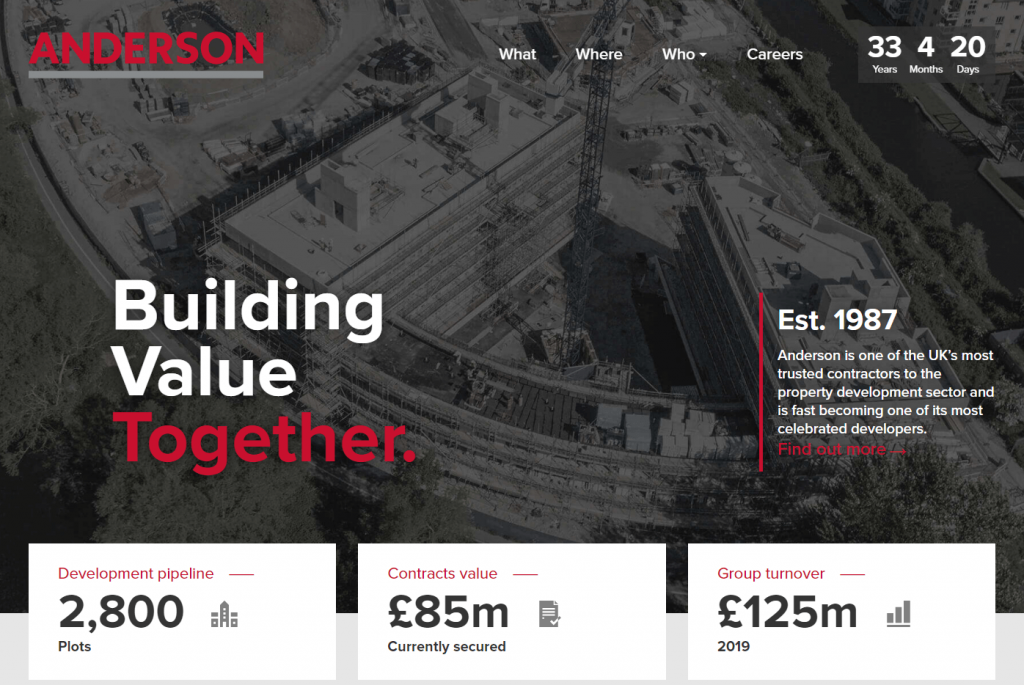
Some great photography and moody atmospherics helps give the site a dramatic intrigue and a certain magnetic appeal.
BALFOUR BEATTY
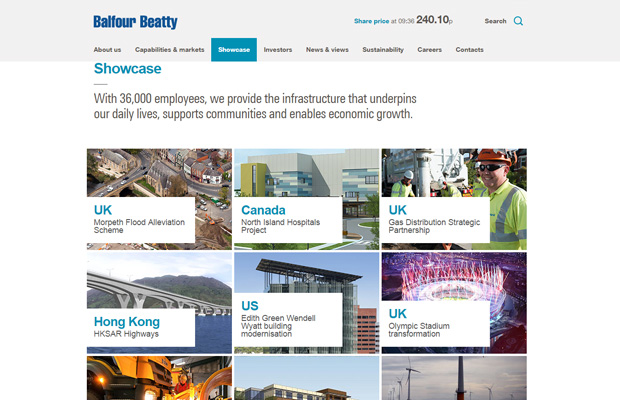
A really good showcase of global projects making Balfour Beatty a powerhouse when it comes to international infrastructure operations.
BECHTEL
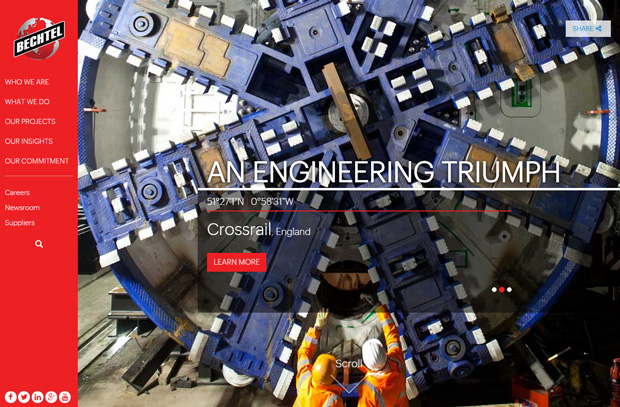
A superior website from one of the most respected engineering, construction and project management companies in the world. A pictorial feast of engineering wizardry.
GRAHAM
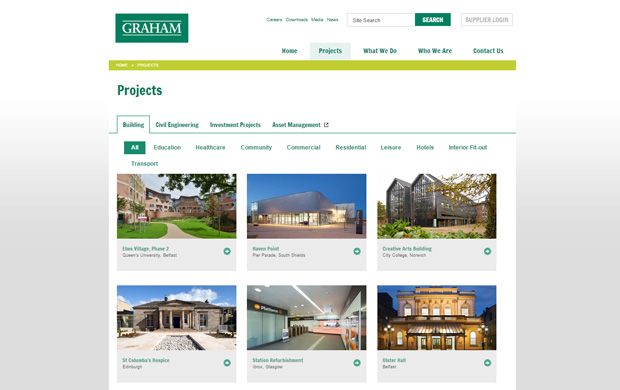
A vast array of impressive infrastructure projects throughout the UK. The showcase menu is structured well and easy to read – a nice touch with each project swapping around when scrolling across the sub headings in each category.
KIER
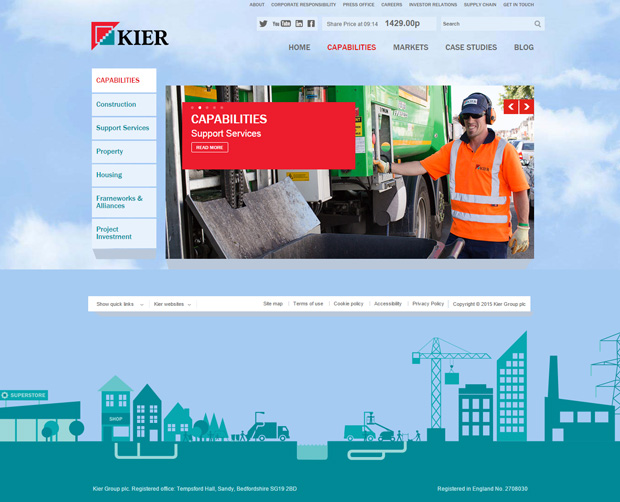
A fun vector graphic used as a footer showing in simplistic form of some of the services that Kier provide from construction and property development to facilities management and project investments.
MASTERSON HOLDINGS
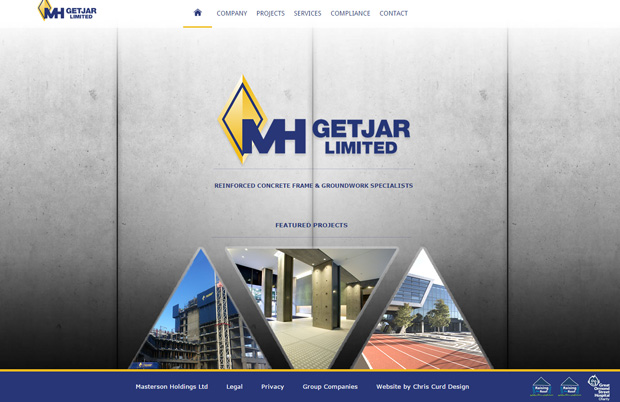
The use of a concrete image for the background makes for a very masculine website and in the words of the Ronseal ads ‘does exactly what it says on the tin’ – after all the company are reinforced concrete and groundwork specialists.
MORGAN SINDALL GROUP
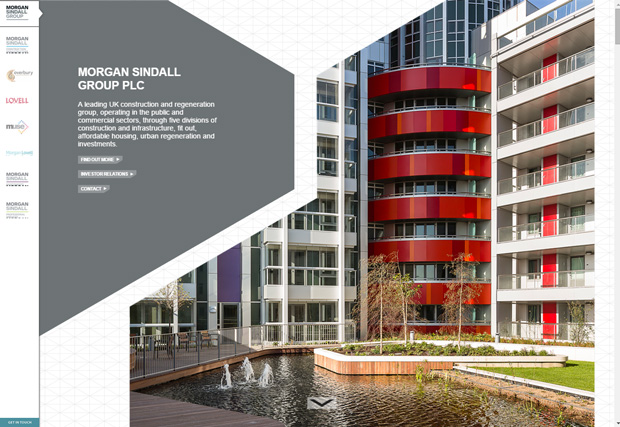
The triangular grid background of this website forms a good basis for the geometric shapes of the imagery and text panels to work together. The movement of these layers shifting independently when scrolling down gives extra appeal to the browsing experience.
RG CARTER
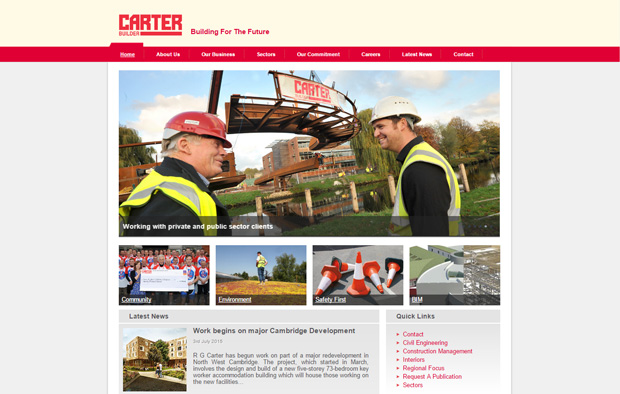
www.rgcarter-construction.co.uk
A straight forward layout design making the navigability very easy especially for the uninitiated.
SHERRI BUILDERS
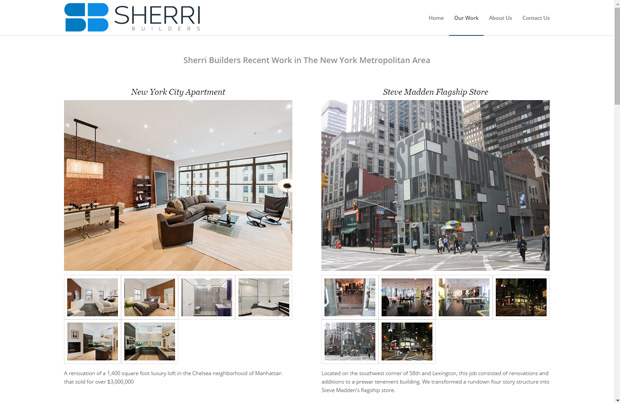
Very professional imagery used made all the more interesting with the way that each image emerges into view giving the site a more dynamic feel.
WILLMOTT DIXON
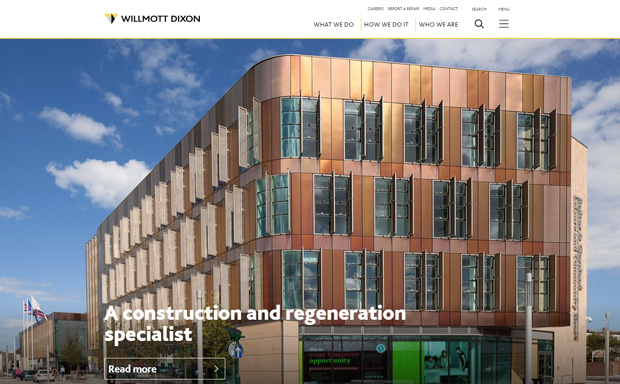
A visual treat showing full width photography for the greater impact emphasizing WD’s commitment to being proud of their chosen industry and in particular their achievements.
If you’re interested updating your web design or digital marketing strategy, then get in touch with us today!
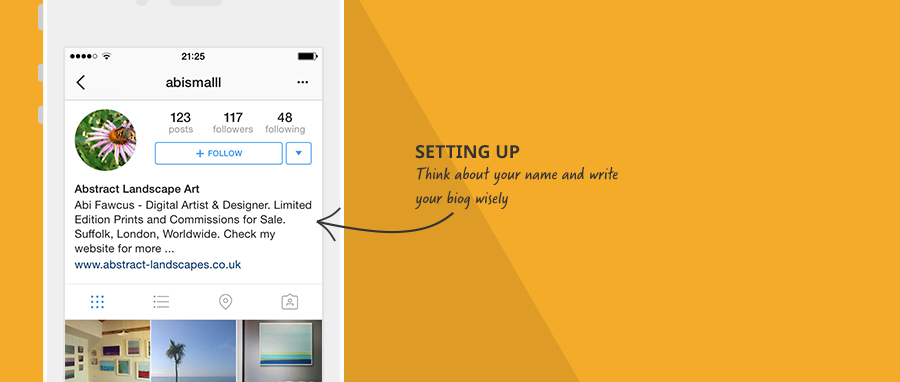
I already had an account with around 29 followers (pretty meagre). But if you haven’t you need to download the app onto your phone and set up an account. To aid being found I recommend both your username (known as a handle with the @ sign) and your name having reference to what you do in it. For example I set my name as Abstract Landscape Artist. You are then more likely to come up in a search of your your specialism.
Write your biography wisely and link to a relevant page on your website in the URL (web address) field. This is the only small area you have to promote what you do and direct people away from Instagram.
Then choose the amount of times you think you can feasibly post each day and get started. I went with one but three is optimal.
Your pictures need to be good. Look around, there is a very ‘glossy’ magazine feel to Instagram. It is also starting to be more common to see the animated gifs or video loop images offered by new smart phones.
Friendly and kind. This is not twitter.
People are more reserved about who they follow than on other social platforms, they are much more likely to ‘like’ than give you a full resounding follow.
Etiquette seems to suggest you should have more followers than be following.
Make sure you use the hashtag (#) in each post.
The only way for you to reach those outside your own following is including a hashtag they may be interested in. Think clearly about what subjects your audience would look at and make sure that your hashtag includes:
Six hash tags is about right. if you want to set your hashtags away from your post text, you will often see people use ‘–’
For example;
This is the text for my insta-post
—
#hashtags #subject #location #etc
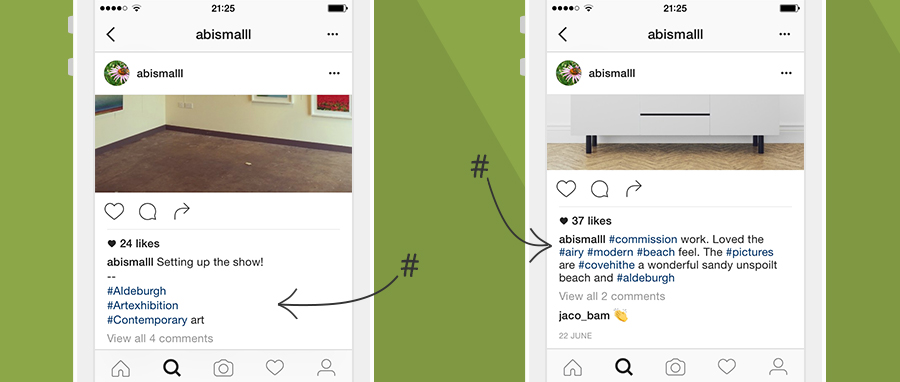
You can indeed increase your following by good old fashioned hard work.
Quite excited I surfed around on Instagram looking at people trending on hashtags similar to the ones I was using. I commented on their pictures and in return got some nice comments back, a few likes and some thank yous but not really any follows.
I checked out the ‘settings’ tab on my instagram and under ‘Find & Invite Friends’ trawled my contacts stalking anyone I had ever known – and followed – with not that much response.
Then I looked at ‘Suggested Users’ and, being a little more sensitive here, I liked or commented on their images and then followed. The response was good, better than my real friends! I got quite a few follows back and increasing likes.
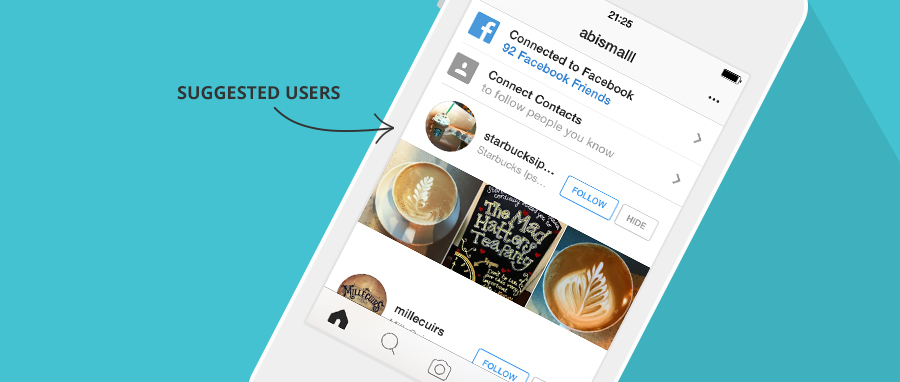
So I now knew that if I made the effort to look, comment and then follow I was more likely to get people taking the time to look at me and follow, but more often it started in lots of likes. I found if I checked the ‘grammers’ that had left likes (but no follow) commented or posted on their feed, then followed them I was getting a higher rate of follow returns.
I also noticed that my activity and engagement was snowballing I was reaching wider and growing likes, comments and follows.
Next I checked how my time of day was affecting numbers.
Currently I was posting at 9pm so I tried at 7am and 12pm. The numbers were considerable; midday doubling and early morning tripling so I moved my daily post to 7am.
Small trick – I also learned to cull dead followees, those I was following who were not attentive to my path to greatness.
I did some real world research.
I went about my day asking anyone I could what they thought of Instagram and how it worked for them – there are definitely industries that thrive on Instagram and I found many people and small businesses for whom Instagram is a brilliant marketing tool bringing them many sales. These industries are generally fashion, food, lifestyle and outdoor adventure.
So what if you aren’t in one of those industries?
In one word….Keywords.
#Hashtags are key but tagging just for ‘your’ industry is not a way to approach a wider audience so I started #ing the industries that worked. Adding #interiors #interiordesign #womensfitness #wheretonext and apparently blueberries and donuts do wonders for likes too, but no, even I had a limit to how low I would stoop. That said using the hashtags from popular industries definately increased likes which in turn after I had engaged, cultivated follows.
You can see a few popular hashtags in this article; www.postplanner.com/best-instagram-hashtags
So numbers were growing, this was great wasn’t it?
Now I just focused on those liking my posts. I checked them out, liked, commented and followed. This showing of interest in them over just following increased my follows, but as this grew as did my time responding and although I discovered new, nice and interesting stuff it was taking up my time which should have been spent doing actual work.
‘I wasn’t doing this out of enjoyment but for the benefit of my business’
Unlike pinterest where I surf just to find ephemera and inspiration I wasn’t doing this out of enjoyment but for the benefit of my business, this is very different from using a social platform for social or personal purposes. So was the return on investment enough for the time (and therefore money) I was spending?
I was pleased, I had more than tripled my following and it was easy to see that this was a snowballing effect. As I continued posting and tagging once a day, my numbers were growing at a much quicker rate than the virtually ‘zero’ movement before this experiment.
There is no doubt that Instagram, and all the other social media platforms help build very successful businesses, however choose wisely, test, decide, create a strategy and importantly – stick to it. Even those that have millions of followers all say it is hard work, and just posting with the odd hashtag and sitting back and waiting will not bring you riches.
With 300 million active daily users on instagram yes that means you have a far reaching pool but it also means you have a big ocean to navigate through, with your lone voice needing to rise above other – dare I say – natives, and many millions of those are of course not interested in your line of business.
Yes and no. Social media is not a magic wand but if you choose your social media platform carefully, have a strategy and a campaign – and stick to it – it is likely to work. But sporadic posting across random platforms is less likely to help your business and more likely waste you time.
Stats on conversion rates seem to vary considerably but most say social platforms are around or below 1% with newsletters being much higher than that so finding the right platform and finding the right person (not everyone has the knack) is an expense that needs to be factored in. In the end, social marketing is no different from traditional marketing, find what suites you and stick to it, routinely making sure the return is worth the outlay.
You can find a large selection of stats here if you want to know more: www.expandedramblings.com/
And finally, if any of these alarm bells have rung for you and finding the right marketing avenue to turn down is on your mind why not give us a call.
All our advice is born out of hands on experience and delivered with unbiased recommendation.
Statistics show that Instagram has overtaken Twitter in active users but Twitter still has far more posts shared each day (500 million tweets v. 80 million instagram images) but what do these statistics mean for me?
Both have a very similar demographic but the main difference is that Twitter is a great platform for sharing content, users can automatically post or share from other social platforms or from a blog, therefore quickly getting content into Twitter to encourage users back to your website or main marketing platform.
Instagram on the other hand is very much ‘in app’ with the user’s complete attention as they are unable to click to go to blogs, videos or outside links. Marketing campaigns must centralise around engaging audiences completely within that platform, not spring boarding them out (of course there is always ways around this) but it is quite a different approach to marketing that needs to be thought about.
Instagram is tapping into a community of very visual consumers, image quality is everything and a great place to build a brand and loyal followers. Whereas Twitter is good for sharing content and interacting quickly with customers, so much so that many large online organisations use Twitter to deal with ongoing support issues.
One thing is for sure that the digital landscape doesn’t stand still. Do you remember Myspace and Friends Reunited? The rise of Facebook that was then threatened by Twitter and now Instagram. So it is a pretty safe bet that the next big thing will come along and I have always been under the instinct that early adopters to a platform are actually the ones that reap the benefit, they take a risk, start when the pool is small and get rewarded.
So we have Snapchat making waves with businesses already looking to market here to a very young audience, there is also Vine, and many more. Two new ‘Instagram’ style platforms to watch still in their infancy are Ello and Hyper. Both follow a similar strategy to Instagram but Ello’s manifesto is no advertising not ever. And Hyper with a voting system and anonymous ‘secret’ style posting which could be quite interesting for brands, has the backing of Vine.
Ello’s no advertising manifesto is quite interesting as if using social media purely for selling, then advertising is a quicker way to get in front of your audience and so an avenue to think about. And if it is just about selling then thinking which channel of marketing will actually get the best return on investment is incredibly important, and that may or may not be as an active social media participant.
But mainstream social media platforms are not the only form of social marketing. Currently for me my best return on investment is my newsletter – so efforts should be put to getting more subscribers here.
Also looking at industry specific media platforms is another option. These exist for most industries, and as an example if you are a gallery, photographer, artist or interior designer there is SaatchArt or Houzz. Different audiences but they are still social media, and some of the algorithm’s within these platforms don’t require you to be quite so virulent to get noticed which is another factor when looking for the right marketing balance.
These niche platforms on which you can create a following from an audience actively looking for your type of product or service, although there may be less users and less posts than the big 3, they are much more qualified leads.
The thought is not, should I be using Twitter or Instagram, Facebook or Linkedin, the questions is what is my marketing strategy and which platform is going to best suit my business, audience, time allowance and budget. These platforms don’t work for everyone and is spreading yourself thin really going to be more beneficial than a contained effort?
There are, and always have been small factions of people that do things differently, but with the connection of social media their voice can gain traction very quickly. This cool hunting means a wave movement of users across platforms scouted out by those hipster explorers and pioneers, followed by the influencers, then mainstream and marketing bringing up the rear.
This pattern won’t stop it has been going on in a social context throughout humanity but our global connection has made it a much faster and more fickle movement. Standing still as a business has never been harder with such a strong forward current as technology expands and globality contracts.
So don’t just jump on the latest bandwagon as it won’t last but instead use that traditional approach of ‘which type of marketing actually works for us’. Time is money and all marketing avenues should be considered. Social media, although very much a tool in our marketing toolkit is not the free, magical, marketing machine we have perhaps been lead to believe. Research, testing and a firm strategy, with routine and continuity will stand you in good stead – and you never know you may even become an influencer not a follower.
I spent a week ankle deep in Instagram and a few of the other visual social media platforms to give some insider insight in my article coming out next week. But if this is already on your mind and you can’t wait until next month why not give us a call and pick our brains in relation to your business online.
A key Google characteristic in my mind is the long play. They do something because they believe in it, and keep on doing it for as long as it takes for it to yield.
This idealism has anchors in the real world. The pragmatic recognition that revenues come high on the list of priorities saw to it that Google Adwords got plenty of attention in the early years, since when the company has been able to power its way through numerous adventures, perhaps most notable of late being “driverless electric cars”.
Of course, key to Adwords success was the early dominance of the “free” Internet search engine space – which required focus and brilliance – so that the advertising platform could dominate “paid search” in equal measure.
So here is this leviathan, powered by incredible advertising revenues worldwide to which Infotex has paid its dues in a small way over the years. When I overheard Dan, Tim and Ollie talking about “Google Elevator”, I thought “Well, they are making cars, why not elevators?”
So imagine my surprise and delight when we were invited as a (let’s face it) rather small “Google Partner” to join their Google Elevator Partner Business Owners’ Coaching Programme.
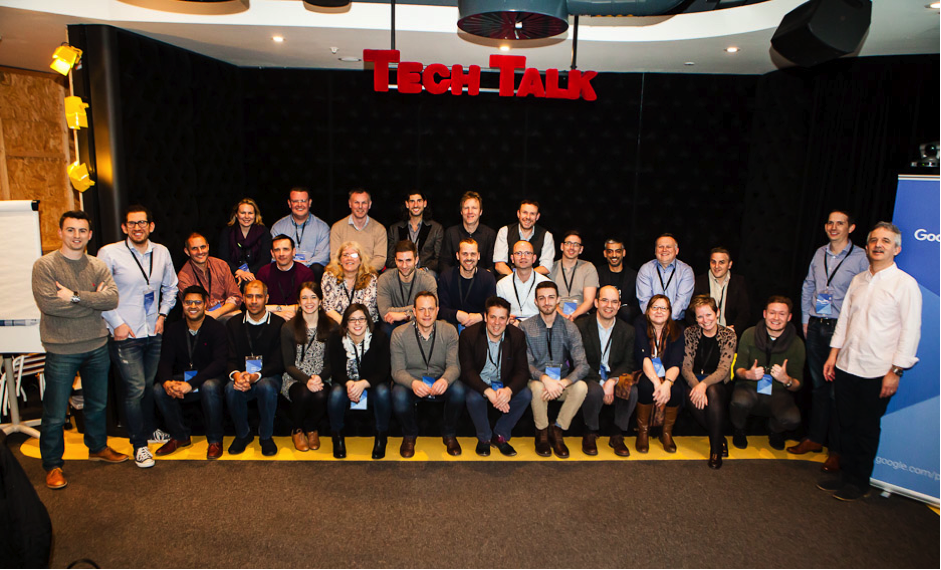
Google have recognised that there are thousands of hard working and intelligent people out there running digital marketing agencies, which when combined generate billions in ad revenues. Often the work of a digital agency is challenging, commercially risky and just plain old hard going. To support this community and help us to do better, a handful of us were selected to join their Partner Elevator programme – these are the agencies in whom Google can see potential, and to whom Google is pleased to give back.
This programme bears all the hallmarks of other Google activity. We have been provided with access to some of the best coaching and mentoring services around. All in Google’s London HQ with the legendary supplies of food and cupcakes. Headed up by Robert Craven of The Director’s Centre, a team of his consultants and Google staff have provided us with workshops, books and one-to-one coaching sessions to use in any way we wish for the improvement of our businesses. Very Google.
For me this has come at an ideal time. Infotex is 12 years in the making, and I am 53! We have a great company that has already covered a lot of miles and has real strengths. The time is right for us to look to the future and crystalise our vision for 2020 and beyond.
Robert and his team are inspiration combined with pragmatism – just as you would expect with all things Google. Here at Infotex we look forward to sharing insights over the coming months and how this experience will help you our customer.
The golden arches in any country gives me a craving for chocolate milkshake, a small apple with a bite taken out of it implies luxury technology and a mulberry tree makes me want to sell my husband just to get my hands on a leather bag!
The past couple of years have seen a number of brands alter their logo and 2015 saw the Infotex logo evolve and develop (more on this from our Design Director Abi Fawcus next month). But why did these companies change their already well-known brand symbol?:
1. TO ADAPT TO A CHANGING MARKET:
This year we saw the Google logo had its biggest redesign since 1999. The change was based upon how people react to Google across “many different platforms, apps and devices.”1 The typeface of the new logo is ‘product sans’ which combines “the mathematical purity of geometric forms with the childlike simplicity of schoolbook letter printing”. The renowned four colour is seen across the brand even featuring in the microphone design when using voice controls on your mobile.


Thetrainline.com has also adapted to the mobile market by changing their name to simply Trainline. They launched a new mobile app to illustrate their new brand concept of ‘Smarter Journeys’, with the CEO Clare Gilmartin stating that their “mission is to help people travel smarter, and by using their phones they can enjoy the advantages of saving money by buying in advance and ensuring they have real time travel updates during their journey.”2 The #IAmTrain campaign was also launched to promote the change with a heavy emphasis on using social media to promote the new mobile friendly brand.
2. IN RESPONSE TO A MAJOR CHANGE IN THE COMPANY:
Pizzahut has recently redesigned their logo in response the their biggest menu change in years. Dubbed as the ‘Flavour of Now’ this new menu is seen as a response to their recent stagnation in the market and this logo change is used to help the transition. The Vice President of Marketing commented that “Any good flavorful pizza starts with a sauce swirl”3 which is what inspired the red swirl on the edge of the logo.

3. TO PROMOTE A NEW BRAND IDENTITY:
Airbnb completely changed their brand positioning in 2014 by promoting the sense that their customers can ‘belong’ in any of the properties rented through their website. They introduced their “Bélo” logo – “It’s an iconic mark for our windows, our doors, and our shared values. It’s a symbol that, like us, can belong wherever it happens to be”4
4. A BAD RESPONSE TO A LOGO DESIGN?
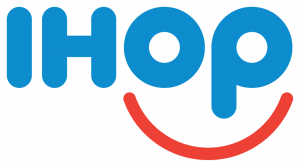
American restaurant giant IHOP (International House of Pancakes) changed their logo for the first time in decades this year. They have simplified the logo but the most major change is the red line below IHOP from a downward to an upward curve. According to the company’s Vice President of Marketing, the old logo “appeared as a person’s frown.”5 Instead he believes that the new and more positive logo will be more attractive to customers and “make them smile.”
5. FOR THE SAKE OF CHANGE?
Facebook have made very slight alterations to their logo using a custom typeface to “modernise the logo to make it feel more friendly and approachable”6 (Josh Higgins, Facebook’s creative director). The most noticeable change is the “a” which is fuller and rounder.


1 Evolving the Google Identity
2. thetrainline.com Rebrands itself to Trainline
3 Inside the Pizza Hut’s Saucy Rebranding
5 IHOP Changed its Logo, says the old one looked like a frown
6. Facebook unveils new logo in stunning change for fans of the letter A
What is this?
In the advent of powerful off the shelf platforms such as WordPress, Shopify or Magento, the cost of buying a website for many businesses has been considerably reduced. This is great news. Never missing an opportunity designers and coders of all abilities have started designing templates to accommodate most types of businesses on these platforms.
Well that’s great isn’t it?
These themes look beautiful as the designer has perceived them but they don’t always look so good once your business has been shoehorned into it. Nor do you ever quite know what is under the lid; leading in some cases to problems with updating platform software or browser compatibility.
What does it mean for me?
Understanding your requirements and constraints and offering you the best solution or sharing with you the options is core to how we work. There is no doubt that done properly themes can save you time and money. So we have hand-picked a selection of themes and use them as building blocks to create a website that will fit you but is guaranteed by us.
Here is a quick check list to give you an idea of whether a pre-built or custom theme would work best for you.
A pre-designed theme is great if:
A pre-designed theme is not so great if:
Discover how our team can help you on your journey.
Talk to us today