Infotex have long been users of Cloudflare, creators of a range of technologies to secure, optimise and speed up websites.
Connect on Tour London is their annual in-person showcase that details Cloudflare’s latest features and what’s on the roadmap. We sent Infrastructure Manager John Harman along to find out more.

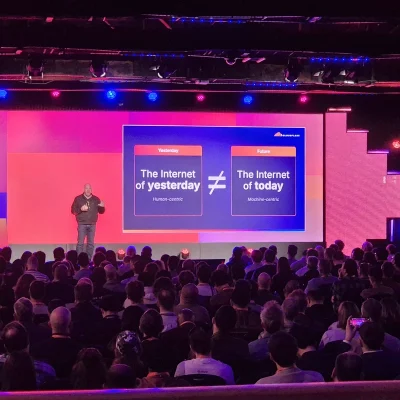
Held at The Brewery in central London on 15 April, the event brought together (‘Connect’ed’) around 1,200 attendees to hear how rapidly things are changing, meaning that the Internet of yesterday isn’t the Internet of today, and will be very different to tomorrow’s.

Scale
The event highlighted the vast scale that modern CDNs work at with data centres in 335 cities across 125 countries, transiting over 7 trillion requests per day and over 500Tbps of bandwidth capacity – these are figures that it’s hard to get your head around. It also gives them a unique perspective on what is happening across the web both in terms of witnessing hundreds of billions of attacks per day and being able to identify good and bad actors amongst this fire hose of data, speed is at the centre of everything they do, that includes developing new protocols for the web and building out enterprise class AI models that can identifying the purpose of a visitor in milliseconds (compare this to the seconds, or minutes, that ChatGPT takes to respond).
For businesses trading in so many countries with different laws, the challenges that these pose were evident, and Cloudflare’s localisation and “edge compute” that runs developers’ code in the viewer’s country provide a compelling offering for compliance.
Automation and Bot Traffic
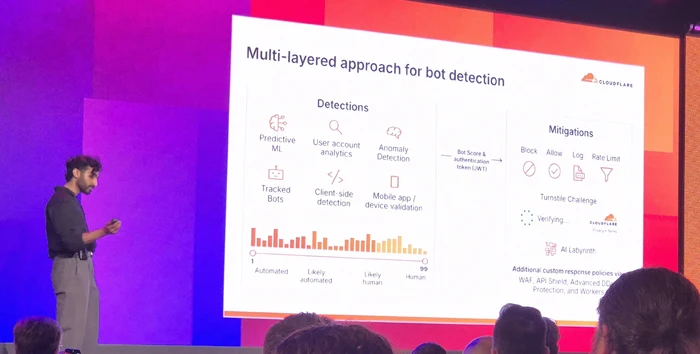
Naturally, a common theme at the event was the agentic web, over 50% of global traffic is now bots. Some of these, such as GoogleBot, are beneficial. Others are scrapers posing challenges to the revenue model of ad-funded content and news sites while posing opportunities for e-commerce stores. With bots always evolving, it is harder than ever to identify good from bad, but Cloudflare’s latest technology allows clearer identification of bot traffic which can then allow, rate limit or block as applicable.
AI
Cloudflare know they have to help AI training bots understand their clients sites as efficiently as possible, and during the day showed off features such as using AI to generate bot-ready versions of web pages on-the-fly to both reduce the tokens, and bandwidth, needed to consume the content and help their clients rank most highly.
Similarly, their tooling allows site owners to use AI to identify and control those training bots, they are even taking that a step further with means to charge the bots for access to valued content.
With the proliferation of AI MCP (Model Context Protocol) Cloudflare showed how their traditional WAF (Web Application Firewall) tools are being updated to provide protection for API and MCP endpoints to prevent malicious actors from attacking these and potentially breaking outside their intended boundaries (guardrails), effectively pitting good AI against bad AI.
At the other end of the spectrum, their enterprise clients are utilising Cloudflare’s AI models to compute responses on Cloudflare’s edge servers that are located close to the viewer for ultimate performance and in some industries regional compliance.
We also heard how AI has allowed lawyers processing data breaches of non-Cloudflare systems, to turn months of manual labour into a few days, allowing impacted parties to be notified in more timely ways than ever before.

When the web is moving at such pace with risks at every turn, it is great to see that there are good guys who’s mission is simple – “To help build a better Internet”.