
It ensures our systems are up to date, secure and fit for purpose meaning our clients can rest assured that they are working with a business that is confident in its digital security. Plus, we have the hands-on knowledge to guide their security measures when we develop their websites and systems.
By having a clear picture of our organisation’s cyber security level, we can remain vigilant and keep ourselves ahead of any risk. Further securing our position as a reliable and trusted provider, particularly in the more heavily regulated industries and strengthening our position to further support larger government-backed organisations.
We signed up for Cyber Essentials Plus as part of our ambition to be transparent, accountable and authentically proactive for higher standards of security and support – meaning our clients can be confident they are in a safe pair of hands.
Our Cyber Essentials and Cyber Essentials Plus reviews were overseen by URM Consulting Services.
Why PLUS is different – self-assessment and independent review of our position
We decided to work to achieve the higher assessment level – Cyber Essentials Plus which ‘To achieve Cyber Essentials Plus, you must already be certified to Cyber Essentials. Gaining the extra qualification will also involve a technical expert conducting an on-site or remote audit on your IT systems, including a representative set of user devices, all Internet gateways and all servers with services accessible to unauthenticated Internet users. “
Working with Lauren and the team has allowed us to elevate our security measures and we can step confidently forward knowing we are in the best position to support ourselves and our customers.
We signed up for Cyber Essentials Plus as part of our ambition to be transparent, accountable and authentically proactive for higher standards of security and support – meaning our clients can be confident they are in a safe pair of hands.
URM’S assessor commented, “Infotex has a strong set of controls in place and an exemplary patching process where the organisation is applying the most up-to-date operating systems and system software which provides both security and stability.”
Richard Howlett, a Lead Developer at Infotex said ‘We are very proud of achieving Cyber Essentials Plus certification. Infotex has made some significant investments in its cyber security infrastructure and this external validation provides a clear demonstration to our clients and partners of our commitment to protecting the organisation from cyber-related attacks.”
Understanding the bigger picture, and the impact COVID and working from home measures have had in the background of businesses.
“The government reports that as many as two in five UK firms have experienced cyber attacks in the last year.”
Throughout the assessment process, we learned that many businesses have experienced issues similar to ours.
Martin Jones, who leads the Cyber Essentials Plus initiative commented “During the COVID-19 pandemic, a significant number of organisations have struggled to keep up-to-date with the latest patch cycles and security updates as the patching systems were kept on the local network. With many, if not all, machines being remote, the patches could not be applied effectively. Some organisations have relied on end-users to apply patches manually, but this relies on the users’ technical aptitude and conscientiousness.”
A significant portion of the effort surrounding mobilising our staff to effectively work from home was the proactive management of our IT kit by our talented and experienced staff members.
This was a key concern for our team, as our stability and security mindfulness directly impacts our clients and their business. We decided to boost our online resilience by taking the proactive steps to work with the team at URM Consulting Services to thoroughly assess our position, and take any necessary corrective steps.
“Infotex managed to keep their applications up-to-date despite the challenges being faced. They achieved this by applying updates remotely and by keeping the number of applications they use to a minimum hence reducing the effort required.”
If you would like to learn more about what we did, and how we can support your business – give us a call. Every project starts with a chat.
Infotex’s primary base of WordPress sites are not affected by this but do check your external systems.
First developed in 1995, Java is a popular programming language that you may be using without even knowing it! All Android phones are based on the Android Runtime which is itself a derivative of Java.
Java is a very structured language known by developers for embodying Object-Oriented-Programming methods and being platform agnostic, i.e. code written in Java will run equally well on Windows, Apple’s MacOS, Android phones and a plethora of esoteric platforms.
At one point it was commonplace to embed Java “applets” into web pages, however due to the power of Java this was found to be a very risky practice and modern browsers do not permit this.
In computing most systems output status updates for diagnostic purposes, some systems make these available to users while others hide them from public scrutiny by writing to logs thus allowing developers to understand what went on when something failed.
Log4J is a utility overseen by the well known Apache Foundation which is coded in Java and is designed to process log requests either from Java applications or third parties and can apply a raft of highly complex rules to understand when a status update is routine vs. critical in nature.
Because it is so powerful yet easy to configure, this has been used in a wide variety of purposes, both bundled with Java systems and deployed to process logs from other systems (one example might be to take web server logs and promptly raise a support ticket when certain classes of error occur).
There is a highly publicised bug in Log4j from version 2.0-beta9 – 2.14.1 which is technically known as CVE-2021-44228 but more commonly by the nickname “Log4Shell”.
This was announced on 9th Dec 2021 before its maintainers were even aware of it, it appears attackers had been taking advantage of it for at least a week prior and as such is given the “Zero-day” moniker and scores the highest possible severity rating of 10/10.
Basically, on systems not configured with formatMsgNoLookups, the vulnerability allowed an attacker to create a request which would be processed by Java’s Naming & Directory Interface (JNDI) and would cause the server to make an external request and potentially execute code provided by a third-party attacker. That’s about as bad as things can get when a system is intended to process logs that anyone can initiate in web scenarios.
There are already reports of attackers using this bug to run bitcoin miners earning money for the attacker on afflicted servers.
Fixes were provided by log4j’s maintainers in version 2.15 with a subsequent release to more fully disable potential attack vectors in 2.16.
The US Cybersecurity and Infrastructure Security Agency (CISA) estimates that there are hundreds of millions of devices that are (or were) vulnerable to Log4Shell.
Infotex’s core online platform is WordPress which runs on a PHP platform and none of our log processors run log4j, nor do our client servers have Java installed.
As such our primary base of client sites are not affected.
Since the news of this vulnerability broke on Friday our team reached out to a number of specialist suppliers who offer services (e.g. custom search facilities) to specific clients which could be impacted and have received confirmation from those suppliers that fixes are being, or have already been deployed.
We have also evaluated a number of tools that we use internally (Log4j is also in use on some desktop utilities although the window of opportunity for an attacker there is minute as those systems are not available for attack online) and we have installed updates where applicable for these tools.
We frequently recommend Cloudflare as a security & performance option to clients and it is worth noting that any websites with Cloudflare’s WAF deployed were protected from attack soon after news of this issue broke as they enabled an emergency firewall rule to block potential exploits.
If your website is managed and hosted by Infotex then the likelihood is that you do not need to take any action. If you have websites hosted by anyone else, then you will need to check with those respective hosts to clarify their position. You should also check that you do not have any vulnerable installations of Log4j on your desktop or devices within your business, as it can be utilised in desktop programs.
There are several resources online trying to pull together software vendors statements clarifying whether any updates are needed etc.
One such list can be found at: https://gist.github.com/SwitHak/b66db3a06c2955a9cb71a8718970c592
Keeping your computers and website safe is a constantly evolving challenge and requires co-operation from all parties and this demonstrates the need to know who provides what and ensure that they are managing those systems effectively.
Behind all the glamour of new and redesigned websites, a large part of Infotex’s time and energy is spent “keeping the lights on”, i.e. managing all the little bits that ensure your website remains fit-for-purpose.
Much of this work is never directly seen by clients or website visitors, so in this article we wanted to let you know of a few bits that we’ve been working on recently.
WordPress is a platform that never sleeps; powering around 1/3rd of all websites, it is constantly under scrutiny, having features added and bugs fixed. As a result, the WordPress team publishes major updates around 3-4 times per year and some plugin authors push out updates very frequently.
Infotex’s policy from hard-earned experience is that, with the exception of security releases, it is best to apply updates in a timely manner but not immediately after release. This is because it is often the case that new updates to the WordPress core cause compatibility issues with plugins and/or themes, which can be annoying to our customers and time consuming to work around, yet are often patched by the plugin authors within a few weeks.
We have just finished deploying WordPress 5.8.1 to our fleet of sites under maintenance contract.
In the last month, we have also separately installed security updates to plugins which were evaluated by our team and felt to be of an urgent nature – such updates are often installed within hours of their release to keep our clients safe.
We are in the process of changing the architecture for some legacy sites to allow us to perform updates more efficiently (especially updates of commercial plugins). And automated testing will come online soon, to further improve the customer experience – more on this in due course.
Just as WordPress itself is constantly evolving, so are the servers which we host it on.
All of these servers are checked for security updates at least once per week to keep them secure.
We have now started to deploy the latest evolution of our preferred server operating system, called CentOS Linux Stream 8. Stream is the future of CentOS Linux and will allow us to offer newer technology earlier in the lifecycle than was previously possible. We will be migrating sites to this platform over the coming months. In addition, we are working through the process of testing and migrating our fleet of servers to PHP 7.4, which gives the latest features and performance benefits. In some cases this upgrade is requiring changes to our client websites to provide compatibility, but we aim for the change to be seamless.
With SSL/TLS now being a defacto standard on websites and email solutions, we continue to create internal automation to both monitor and renew these sooner (we now typically renew website certificates every 60 days, as short certificates provide additional “defence in depth” security benefits) and have recently renewed and upgraded the strength of the certificate that protects our Flexidial client email system.
Infotex are proud of the technical standards we work to and have recently decided that the time is right to demonstrate this. We are therefore currently working with external advisors to obtain the Cyber Essentials and Cyber Essentials Plus certifications.
For those who are not familiar, Cyber Essentials is a program backed by the UK Government’s National Cyber Security Centre (https://www.ncsc.gov.uk/cyberessentials/overview) to verify that we are providing controls to mitigate the majority of cyber attacks and demonstrate that we can, and do, handle your sensitive data correctly.
To be clear, this is not related to DDoS type attacks but instead demonstrates controls (including timely installation of security updates and use of multi-factor login to our core systems) that will deter the much more common hacker attacks in addition to demonstrating security awareness and controls to reduce the likelihood of Infotex suffering from the ransomware attacks which are sadly so prevalent today.
Related to the above two items, over the last year we have invested heavily in new computer hardware for our team members to ensure that everyone has an environment which allows them to make the most of their skills in turn delivering the best technical solutions and advice for our clients.
As any regular readers will be aware, the GDPR is an act of the European Parliament which came into force in May 2018. It is designed to give individuals (formally called data subjects) far-reaching control over their personal data with severe penalties for any bodies (formally called data controllers) who cause a data breach that fails to protect that data or act in accordance with the existing agreement with the individual.
Two of the key tenets of the act are the right of access and the right of erasure:
A Data Subject Access Request could be summarised as allowing the individual to ask a data controller what personal information it, and it’s sub-processors, holds about them and to request a copy of this data in addition to being transparent about how this data is processed on their behalf. Typically this takes the form of an email or online form that the individual will complete with their name and minimally identifying information which is sent to the controller who responds with the full data set in the most human-readable form possible within 30 days.
The Right to Erasure, also known as the right to be forgotten, is similarly summarised as allowing individuals to make a request instructing that the information previously provided be deleted in whole or in part, which the controller must comply with by erasing or pseudo-anonymising this data in such a way that it can no longer be linked to the individual.
GDPR is certainly well-meaning and as is so often the case the issue arises in the implementation of these powers by Data Controllers.
In short, attackers have discovered that many companies, in their role as Data Controller, do not validate who made the request before providing or erasing the data.
Let’s take a simple example, our attacker is looking for information to conduct an identity fraud against Mr Bloggs, they contact Company A who receives an email looking like the below:
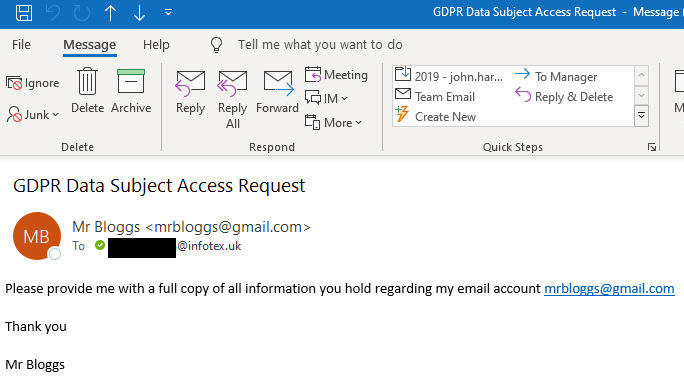
Stop for a moment and imagine you received this request with your email address in the To: field. Would you process the request and reply to Mr Bloggs with the requested information?
Are you quite sure??
Look carefully at the below screenshot of where your reply would actually be sent to:
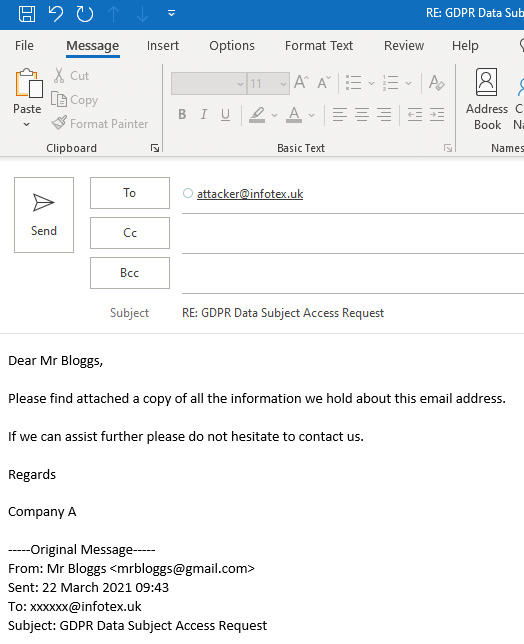
The trick here is that the attacker utilised a long-established email header called Reply-to causing the original email to appear to be faked to originate from mrbloggs@gmail.com while the response would be sent back to an entirely different address, attacker@infotex.uk in this example.
If the above response was sent with an attachment containing all the personal information held about Mr Bloggs, then that personal data would now be in the hands of the attacker helping them to conduct whatever identity fraud they had in mind.
By the simple act of sharing this information without Mr Bloggs explicit consent Company A have just unwittingly caused a data breach, for which they could be prosecuted under the very GDPR that they thought they were complying with.
In the case of Right of Erasure requests, in many cases companies who receive such requests simply permanently delete, or anonymise, the customers data and reply confirming that this has been erased. This can be even worse as there is no need to send a reply-to header, simply fake the email address which the request came from and you have just deleted Mr Bloggs data, the first he knows is when he next contacts Company A and finds that they no longer know anything about him, potentially losing any files, order history, product warranties etc held by them on his behalf.
In this instance if requests are blindly processed then even without a reply-to header the data has been destroyed before the actual individual knows anything about it, perhaps the attacker may add a CC so that the company can let them know that the data has been deleted as well!
The first thing is to ensure that you scrutinise any requests received, in particular ensuring that the email address you are replying to is the account you hold on record.
As the act allows up to 30 days to comply with such a request you may also wish to send an email or call Mr Bloggs (ensuring not to reply-to the original email) to confirm & validate the request, this may also give customer service benefits allowing any grievance that has led to a legitimate request to be dealt with more amicably while also allowing a legitimate customer to respond and query the request.
If you have automated systems to process requests, test how they handle reply-to and CC email headers to ensure that they are not allowing data to be handled in unintended ways.
Credit to Hx01 (https://twitter.com/hxzeroone) whose paper inspired this post.
Infotex maintains and supports more than 700 websites belonging to over 600 of our clients. We regard keeping these websites secure, stable and fast on our servers as being of equal importance to their original design and build.
So we thought we would share with you some insights to the sort of things we get up to behind the scenes. The bulk of the work is either carried out by, or under the direction of, our infrastructure manager John Harman, aka “Moz”, who has worked in Infotex since its inception 21 years ago(!).
We call this series “keeping the green lights on”, because Moz’s main aim is to avoid any amber or red lights coming on …. And if they do, he likes to be the first to know about it, so he can resolve issues quickly.
All server loads are checked daily along with validating various health metrics such as disk/memory/processor usage and ensuring our backups are all running smoothly.
At least once per week every server is checked to ensure that it has all the latest security updates installed.
In addition to the above updating that is done during routine operating hours we also perform some out-of-hours work to update items which requires taking them offline briefly.
We have recently added new servers to our fleet, this helps our capacity keep up with demand as well as allowing us to make incremental modernisation steps which will soon see us dispense with some old servers that are no longer capable of delivering what we need.
All WordPress sites have been/are in the process of being updated to the latest WordPress version and plugin versions. This is essential in ensuring that our client’s websites remain secure and performant.
For many WordPress clients, we added in some key Infotex baseline functionality for 2 features:
CentOS is a reliable and fast Linux operating system. We are continuing work to upgrade the operating system upon which most of our websites run, to ensure that they are fast, secure and continue to operate smoothly.
We have long recommended using Cloudflare to boost our customer’s site speed and enhance its security. While it’s not relevant to everyone, it is a useful tool to have in the arsenal to protect and improve your site’s performance.

Cloudflare have been around since 2009 and provide their services to over 30 million websites. At its most basic, Cloudflare is a content delivery network (CDN) which sits between the server hosting your website and your visitors, providing a robust performance and security layer before visitors (or hackers) reach the server hosting your site – think of it as a bouncer on the door to your site.
It has two main benefits:
Normally, when a user types www.example.com it is translated to an IP address and sent to our server, and the server responds with the components for the page you’ve requested.
For a Cloudflare site, you type a domain name and connect to the closest server in Cloudflare’s network of over 300 cities. They will then validate your request against various rules so as to recognize and reject nefarious hack attempts such as SQL injection, known bad bots, and content spam. Because Cloudflare covers millions of sites across the world, they analyse over 70 million requests per second to detect dodgy activity and common attacks, stopping them before they get to your site. This scale allows them to witness behaviour across their entire network and use technologies such as AI to detect and block attacks, this even extends to blocking unknown (aka Zero-Day) attacks before any patches are available.
Cloudflare’s scale means that defending against attacks is a daily occurrence and in most cases entirely automated as they defended against over 14 million attacks in 2024 alone and the rate of attack is increasing year-on-year.
As well as this, Cloudflare can ‘cache’ your site, creating a copy on their servers that are distributed around the world, and ensuring greater loading speed. For instance, when a new user visits your site from, say, Sydney in eastern Australia, Cloudflare will have it delivered from our server in the UK. However, when a 2nd viewer in Sydney makes the same request soon after, they will see the copy that’s already stored on Cloudflare’s server in Sydney, thus significantly speeding up the page load. It’s even possible for a viewer from Melbourne, western Australia, to hit their local server and also benefit from that first Sydney viewer, due to regional caching.
Cloudflare offers the benefits of having access to servers located within China which, subject to certain conditions, can be used to provide access to the Chinese markets, which are often otherwise restricted by their government’s tight control of internet access.
Other benefits of caching include the ability to deliver automatically optimised versions of web images, and compress dynamic content, further speeding up delivery time. This can be used to keep hosting costs down. It is also especially useful for sites that need to scale up and down with peaks of traffic (such as during newsletter delivery) but are comparatively quiet the rest of the time.
The customisation options for Cloudflare’s use are really almost limitless, as they have access to a range of rules, and, for more complex requirements, we have created code that is implemented at their regional “edge” servers.
Infotex’s technical understanding and experience of working with Cloudflare allows us to utilise their unparalleled capabilities to the full. The following offer some examples of how Cloudflare has helped our clients over recent years.
We have seen and dealt first-hand with our ecommerce customers being sent ransom requests for thousands of pounds with a threat of taking their site offline. When these requests are (rightly) ignored by our client, their sites are subjected to a huge DDoS attack, where thousands of requests are sent every second, which would often overload the server and take the site offline (and any other sites on that server). Our solution to these attacks has been to migrate the site to a new IP address protected by Cloudflare, which has built-in DDoS protection. This way, while the attack continues, Cloudflare’s protection can shrug it off and enable trading to continue as normal.
Cloudflare has protected some of our clients with high levels of attack traffic originating from countries such as China and Russia, which are not countries they manage their websites from, thus allowing admin, or all requests, from these countries to be blocked by Cloudflare, or be subject to more stringent validation; in either case the viewer would be met with a fully branded page explaining why their request was declined without ever risking the request touching, or slowing, the origin server.
One client needed help scaling their WordPress-powered sites to handle their stories going viral worldwide, but that would operate at a low cost in-between high demand. By utilising Cloudflare’s ability to cache full page contents and use tiered regional caches with code running within Cloudflare’s network to standardise the URLs (e.g. strip tracking parameters) we have been able to create a site that updates the latest content in a timely manner, while achieving a 95+% cache rate on the terabytes of data the site drives. By letting Cloudflare do most of the heavy lifting it keeps our client’s hosting costs much lower than having servers that could deal with the peak demand.
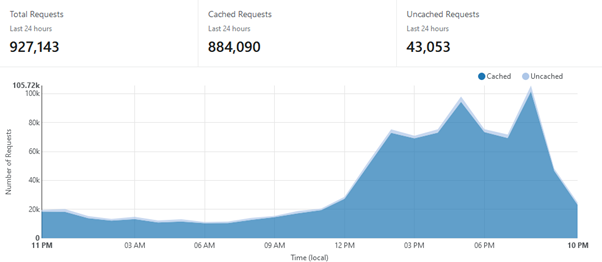
For people sending newsletters there are often unique tracking parameters on website links, meaning that traditional caching would not work. In some cases Cloudflare enabled us to develop code that could run in Cloudflare’s servers to identify these separate parameters, and so we were able to increase newsletter viewership from around a 10% cache rate to over 90%, thus massively reducing the traffic spikes these newsletters cause. In less technical language, it made the pages load quicker and improved the customer experience.
If you’re a prospective, or existing Infotex customer, get in touch about how Cloudflare could help protect your online investment.
Discover how our team can help you on your journey.
Talk to us today