
Welcome to the ever-changing world of investment! Bentley Reid is an independently-owned wealth management company that looks after the financial affairs of individuals, their families, trusts and charities. Their new website is our latest website to be released using the Video Box theme, following on from the success of Zer0es TV late last year. It is effectively a microsite to their corporate website, and shows Video, Audio, and Written reports on investment news.

We will continue to update the site media on a monthly basis to help Bentley Reid keep their clients up to date with the top investment insights.
Check out the new website at https://www.bentleyreid.tv.
Apprenticeships are a great way to throw yourself into a role and learn on the job. Hear from our Production Assistant, Jasmine, about her experience starting out as a Production Apprentice at Infotex.
The team here at Infotex won’t mind me admitting that on my first day as an apprentice I felt quite scared at first! For someone who is just 18, starting out in a new business surrounded by people who are a lot more experienced than you can be daunting. But not a single person made me feel uncomfortable, and everyone helped me in every way they could. It only took a matter of hours for me to learn that Infotex is a very warm and friendly business, and provides that personal touch of friendship that is so valuable, rather than being just a bunch of colleagues.

My tasks involved in my typical day as a Production Apprentice involved:
On top of these roles, I had to complete coursework which made up about 30% of my work. This was probably the most daunting challenge of my year, and involved pieces on management, minute taking, client relationships, staff relationships, and IT exams. I was overwhelmed at first by the amount I had to do, but with a checklist to help me understand which ones were the highest priority, I was able to get through them without any problems. I believe that what I learned most during my year was to do with time management, and getting things to the right people at the right time. In fact, I found the year really rewarding. Especially when I finally passed the whole course, including the IT exam that came with it. It was soon after that that we had an Infotex Christmas Meal at the Riverside Waterfront, where we had a great time as friends rather than colleagues.
Throughout my year as an apprentice, I was guided by my manager, Katie, who made me feel like a colleague more than an apprentice and taught me everything I know, including everything that is still involved in my job now as her Production Assistant: assisting in meetings, scheduling work plans, projects, loading content into websites, and looking after several clients. Katie has always tried her best to understand what I might be struggling with and take that into her own hands by setting up a meeting to teach me the correct way of doing things. I’m grateful to her for allowing me this position and showing me the right direction with my work as we move into the future, particularly more recently, now that working from home has made solid work-relations and connections all the more important for maintaining sanity in otherwise lonely times!
BrewDog’s newest lager – the first supposed carbon-friendly beer – was gifted out to thousands of people early this January. If you remembered to claim your free four-pack, you will be somewhat familiar with Queue-it, the product that enables websites to keep up with surges in online sales through introducing an online waiting room. BrewDog saw 50,000 people at one time queueing for their free beer. Is this the best solution to high-demand website traffic control?
We were reminded this month of just how volatile usage trends for certain messenger apps can be when WhatsApp’s update announcement, misunderstood by many as a new policy regarding data-sharing to Facebook, resulted in millions of users switching to other encrypted apps such as Telegram and Signal. It comes as little surprise that data security is the most sought-after app feature.
WhatApp’s original implementation deadline for the new services, February 8th, has now been extended until May, to make time to regain the trust of its users and explain the real purpose of the updates, which include the ability to offer features such as shopping and payments. https://www.bbc.com/news/technology-55573149
With the masses taking to their screens over the last year, it’s funny to think how different our path could have been had we not had sufficient broadband and data availability to cope with the demands. Ofcom’s Connected Nations 2020 Interactive Report demonstrates how well national broadband is coping with the surge in demand from COVID-19, and how 96% of the UK still has access to high speed internet, the same as was recorded in 2020 before the first lockdown.
Weather forecasts aren’t the most accurate of things, but one inventive website harnesses the power of Twitter users to map snowfall in the UK. Twitter users can tweet #uksnow, the first half of their postcode, and a rating out of 10 for intensity of snowfall, for it to appear on a live map, and let the rest of the nation know they’ll be getting out the sledge. Visit uksnowmap.com when it’s snowing to see how the rest of the country’s doing.
And finally, for a satisfying stretch of the imagination, check out the elastic man graphic on the site that brought us Family Guy: https://www.adultswim.com/etcetera/elastic-man/
We have long recommended using Cloudflare to boost our customer’s site speed and enhance its security. While it’s not relevant to everyone, it is a useful tool to have in the arsenal to protect and improve your site’s performance.

Cloudflare have been around since 2009 and provide their services to over 30 million websites. At its most basic, Cloudflare is a content delivery network (CDN) which sits between the server hosting your website and your visitors, providing a robust performance and security layer before visitors (or hackers) reach the server hosting your site – think of it as a bouncer on the door to your site.
It has two main benefits:
Normally, when a user types www.example.com it is translated to an IP address and sent to our server, and the server responds with the components for the page you’ve requested.
For a Cloudflare site, you type a domain name and connect to the closest server in Cloudflare’s network of over 300 cities. They will then validate your request against various rules so as to recognize and reject nefarious hack attempts such as SQL injection, known bad bots, and content spam. Because Cloudflare covers millions of sites across the world, they analyse over 70 million requests per second to detect dodgy activity and common attacks, stopping them before they get to your site. This scale allows them to witness behaviour across their entire network and use technologies such as AI to detect and block attacks, this even extends to blocking unknown (aka Zero-Day) attacks before any patches are available.
Cloudflare’s scale means that defending against attacks is a daily occurrence and in most cases entirely automated as they defended against over 14 million attacks in 2024 alone and the rate of attack is increasing year-on-year.
As well as this, Cloudflare can ‘cache’ your site, creating a copy on their servers that are distributed around the world, and ensuring greater loading speed. For instance, when a new user visits your site from, say, Sydney in eastern Australia, Cloudflare will have it delivered from our server in the UK. However, when a 2nd viewer in Sydney makes the same request soon after, they will see the copy that’s already stored on Cloudflare’s server in Sydney, thus significantly speeding up the page load. It’s even possible for a viewer from Melbourne, western Australia, to hit their local server and also benefit from that first Sydney viewer, due to regional caching.
Cloudflare offers the benefits of having access to servers located within China which, subject to certain conditions, can be used to provide access to the Chinese markets, which are often otherwise restricted by their government’s tight control of internet access.
Other benefits of caching include the ability to deliver automatically optimised versions of web images, and compress dynamic content, further speeding up delivery time. This can be used to keep hosting costs down. It is also especially useful for sites that need to scale up and down with peaks of traffic (such as during newsletter delivery) but are comparatively quiet the rest of the time.
The customisation options for Cloudflare’s use are really almost limitless, as they have access to a range of rules, and, for more complex requirements, we have created code that is implemented at their regional “edge” servers.
Infotex’s technical understanding and experience of working with Cloudflare allows us to utilise their unparalleled capabilities to the full. The following offer some examples of how Cloudflare has helped our clients over recent years.
We have seen and dealt first-hand with our ecommerce customers being sent ransom requests for thousands of pounds with a threat of taking their site offline. When these requests are (rightly) ignored by our client, their sites are subjected to a huge DDoS attack, where thousands of requests are sent every second, which would often overload the server and take the site offline (and any other sites on that server). Our solution to these attacks has been to migrate the site to a new IP address protected by Cloudflare, which has built-in DDoS protection. This way, while the attack continues, Cloudflare’s protection can shrug it off and enable trading to continue as normal.
Cloudflare has protected some of our clients with high levels of attack traffic originating from countries such as China and Russia, which are not countries they manage their websites from, thus allowing admin, or all requests, from these countries to be blocked by Cloudflare, or be subject to more stringent validation; in either case the viewer would be met with a fully branded page explaining why their request was declined without ever risking the request touching, or slowing, the origin server.
One client needed help scaling their WordPress-powered sites to handle their stories going viral worldwide, but that would operate at a low cost in-between high demand. By utilising Cloudflare’s ability to cache full page contents and use tiered regional caches with code running within Cloudflare’s network to standardise the URLs (e.g. strip tracking parameters) we have been able to create a site that updates the latest content in a timely manner, while achieving a 95+% cache rate on the terabytes of data the site drives. By letting Cloudflare do most of the heavy lifting it keeps our client’s hosting costs much lower than having servers that could deal with the peak demand.
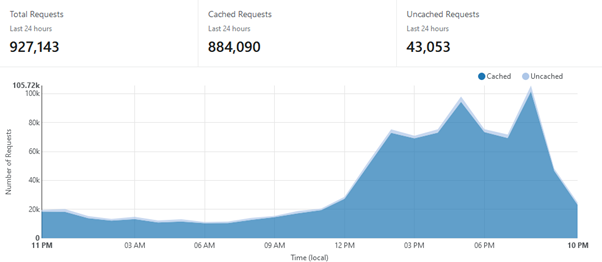
For people sending newsletters there are often unique tracking parameters on website links, meaning that traditional caching would not work. In some cases Cloudflare enabled us to develop code that could run in Cloudflare’s servers to identify these separate parameters, and so we were able to increase newsletter viewership from around a 10% cache rate to over 90%, thus massively reducing the traffic spikes these newsletters cause. In less technical language, it made the pages load quicker and improved the customer experience.
If you’re a prospective, or existing Infotex customer, get in touch about how Cloudflare could help protect your online investment.
Amongst so much uncertainty, the world of web development proves an exciting place to watch the future unravel and people adapt. We’ve picked out some of the best rising development trends for you to be aware of as you browse the internet this year – have you noticed them yet?
Artificial Intelligence has long been enhancing our online user-experience, and chatbots are the next thing here to stay. You might have suspected before whether a person you were live messaging was, in fact, actually a robot: perhaps the giveaway was clunky, pre-prepared sounding responses. But smarter, less detectable chatbots are on the rise.
These ‘conversational agents’ are often used for live-chat customer support, but we are discovering that their benefits range far and wide. For example, UNICEF is using a chatbot called U-Report to help marginalised people in developing nations talk about the most urgent issues in their communities. They use the information they receive to fuel policy recommendations.
Hopefully you’re aware by now that most of your devices, if not all, have the ability to hear you. If not, then you better believe it! And that voice-search technology that you’re becoming familiar with – such as Apple’s Siri, or Amazon’s Alexa – is set to be the new go-to. With a likely increase in the number of people relying on voice search in 2021, voice-search optimization is now at the forefront of SEO and development strategies for websites.
Progressive web apps are essentially websites that feel and function like a mobile app. They have recently gained traction (used most notoriously by Twitter) due to the positive impact they have on user-experience: high-speed loading and downloading, offline use, and push notification sending. Essentially, PWAs are websites that encompass all the best things about a native phone app, but on your website browser.
The growth of web-apps is paving the way for an increase in Website Push Notifications. They work in the same way as regular push notifications on your phone (the banner notifications from in-phone apps). By acting on the permission you give to a website to send you notifications, the push notifications can directly access your screen at any time to show new information. This can maintain higher conversion rates for businesses.
Read our article on website push notifications to find out more.
The adoption of Accelerated Mobile Pages for websites is one of the fastest trending development strategies we will see this year. AMPs were originally initiated by Google to ensure desktop websites can offer the same user experience as mobile sites, the main goal being to increase the loading speed of websites for mobile browsing. This was particularly useful for grasping hold of the short window on offer to grab a reader’s attention online (The Guardian was one of the first to start using AMPs in 2016).
Structurally, the AMP is a (lightweight) HTML copy of a site’s web pages, which enables fast-loading and enhances site performance for smartphone users. AMP pages only take around 2 seconds to load, compared to at least 20 times that for non-AMP pages. You might notice that increasingly more sites are being built through integration of AMP technology (amp. instead of www.) to better the smartphone experience.
Single Page Applications are the key to that all-day systematic scrolling you can’t help but fall victim to. SPAs work inside a browser to offer seamless user-experience by dynamically loading as a single page. This way the user does not have to wait for the site to continually reload, and can enjoy uninterrupted scrolling. They can offer better page performance, data protection, and work efficiently if the user has poor internet connection, as the content loads completely at the first sign of communication with the server. You might recognise SPAs as used by sites such as Facebook and Uber.
Much like SPAs, a single-page website is a website without any additional pages. Content, such as that which might otherwise be found under a “Work” or “About” tab, is fully loaded on the initial page, and can be navigated by links within the one page.
These intuitive and well-structured single-page websites increase the likelihood of maintaining the attention of users, and enables control of the order in which information is absorbed. Also, compared to multi-page sites, the site design and development requires less time and money and is more suited to optimisation for mobile devices.
How do the big sites like Netflix and Amazon hold your attention? I’d bet that personalised content has something to do with how they make you feel so at home. Well now smaller websites are picking up the same idea: personalising site content to suit the individual visitor and decrease bounce rates. So, instead of confronting every site visitor with the same homepage, you can show the most relevant content to the individual, based on data such as the user’s location or device, and increase the chance of turning potential customers into leads.
How’s your website looking in 2021? If you need advice or assistance, don’t hesitate to get in touch with us.
We’ve all been watching the world call predictive analytics to action in the wake of the current pandemic; constant data analysis is driving our predictions of how quickly the virus will spread, how long for, how it will manifest, and so on.
This isn’t the first time predictive analytics have dominated media headlines. As we have seen in recent elections, predictive analytics help election campaigners to determine potential voters – especially the undecided, yet receptive voter – by assembling analysts to interpret large-scale big data. Through this, they target their campaigns on the voters who could potentially be a ‘yes’ vote, as opposed to targeting those who would always be a ‘no’ vote.
As predictive analysis becomes evermore present in our lives, it continues to offer huge potential to drive business in the marketing world. With the growth of Big Data and Artificial Intelligence, the use of predictive analytics can help navigate unstable markets, by enabling informed decisions about future marketing and customer trends.
What is Predictive Analytics?
Predictive Analytics is the practice of extracting information from existing data sets in order to predict future outcomes and trends. It is effective in revealing opportunities and solving problems, and is used in cybersecurity, the improvement of operations and services, and in optimising marketing strategies.
In marketing terms, predictive analytics uses customer data to help businesses adapt marketing strategies to future trends, and to attract and retain their most important customers.
How can predictions benefit your marketing strategies?
Predictive analysis is your best tool in prioritising leads and retaining customers. One of our clients, Nectar360, utilises this to remain as the UK’s largest loyalty program; they make sophisticated predictions from customer loyalty cards in order to help some of the UK’s biggest brands, such as Sainsbury’s, to build impactful connections with their customers.
If you want to improve your business sales strategies, you can start with building small testing models with predictive analysis for your digital marketing, such as running a new specific advertising campaign, and examine how the data grows or changes in order to deduce how it is best to adapt your strategy. By consistently collecting and storing data – such as which device is driving the most leads, or which site features are getting the most clicks – you optimise your campaigns for better lead scoring.
You can also use predictive analytics to look at the mix of traffic on your channels, and their respective conversion rates, allowing you to model estimated sales in response to when particular channels are increased or decreased.
For an international client serving multiple markets we have been able to predict sales revenue across multiple markets, using datapoints from the website visitor behaviours to calculate conversions. Being able to see earlier and more accurately how your website is performing as a revenue-generator is invaluable to inform content marketing decisions.
Predictive Advertising
Google Ads and Facebook Ads use Machine Learning to predict which audiences are best to target, and you can set your budget to more/less, depending on how much you want to impact your sales or enquiry levels.
Many of our Google Ads campaigns utilise predictive modelling tools available from Google’s Machine Learning to predict a customer’s chance of purchasing, based on various points including their search terms, their time of day, their previous browsing and buying habits, and much more. These include exploring estimated clicks and sales based on budgets and utilising their data-driven bid strategies to predict how many sales and enquiries you can receive based on the daily budgets you are willing to spend.
Predictions in 2021: more than just guesstimating?
Usually, forecasting the year ahead in terms of sales, visits or enquiries, would be based on prediction from data of previous years and the current trends. As we look to 2021, however, an uncertain 2021 for many, this kind of analysis may not be as reliable as it has been in previous years.
Nevertheless, predictive analysis remains an important way to help businesses adapt to competitive markets, revealing trends within their email systems, advertising data, social media analytics, or website analytics.
Window swap, for a change of scene
Window Swap let’s you open a new window anywhere in the world, and let’s you leave your working home environment and see from another point of view… anyone can use it! Maybe you want to hear live harpsichord music coming from the street outside Andrea’s window in Italy, or look out over Moscow city from Vladimir’s top-floor window in Russia.
Keeping up with the social media
Both Twitter and LinkedIn have made a leap toward more casual communications by introducing story features: “Fleets” and “LinkedIn Stories”, respectively. These imitations of Instagram’s story feature, which allows people and businesses to post temporary content that disappears after 24hrs, are paving the way for an even faster-paced media buzz. It’s hard to keep up with so many fleeting thoughts, though – there have been reports of Twitter itself struggling under the load.
It’s still all about data
Inventor of the World Wide Web, Sir Tim Berners-Lee, has set to work building a new internet – a startup whose mission is to help people keep control of their data. Inrupt, and its main offering is Solid, lets you store your personal data the way you want to.
Salesforce acquires Slack
You may have seen in the headlines that the messaging app Slack has been acquired by Salesforce. As an avid user of Slack, the Infotex team is already a little concerned about being dragged into the Salesforce net, so we are going to take a closer look at Mattermost in the New Year, with a review to switching over to something more, well, comfortable in our environment.
Premier Equestrian is a family owned and run business that started trading over 10 years ago as a small mobile shop, attending local equestrian shows in North Yorkshire, and also doing yard visits and special shopping days at local riding schools. They now provide a full range of equine & pet supplies, and equipment for both horse and rider.

They needed a new and updated website to make the most of their wonderful products, so we really got the bit between our teeth on this. With over 1,600 products ease of site maintenance was essential, so we created a brand new Shopify site. Shopify will provide the site with a stable home, and the new responsive design includes live search and support for multiple payment gateways.

Search Engine Optimisation is the process through which we can improve search engine traffic to your website, and find the most relevant consumers to increase conversion rates.

Each keyword encapsulates a business opportunity at the exact point the user shows intent. Making sure these keywords represent your business goals is the key to a successful SEO strategy. We target attainable low competition niches and track our positions continuously to give you the best search engine performance.
Our arsenal of industry leading tools allows us to understand your key competitor’s SEO stature. This sets a realistic benchmark and often reveals exciting opportunities that we feed back into your strategy. A universal strategy for every client doesn’t cut it, every industry has different SEO requirements, that’s why we conduct thorough audits in your space before we start our optimisations.
SEO never sits still. Search engines are always looking for the next best way to serve you the highest quality results for your search. We pick up on these changes in Google’s algorithm and adapt our client’s strategy to give them the greatest benefit. If you rest on your laurels you could easily see yourself dropping off the results page, what worked in 2012 would fail in 2017. Having a team with their ears to the ground, looking for these changes, is the insurance you need for your search performance security.
It doesn’t matter if we’re optimising or building – we make sure your site is set up to be Google friendly. Having a solid SEO infrastructure provides a strong foundation to build all future search engine optimisations. Combining the knowledge of our SEOs with our technically gifted development team, positions us perfectly to set you off on the right foot.
Google looks to the rest of the internet to assess the importance of your website. More specifically, they look at other websites links that mention you. This has been a crucial ranking factor since Google’s inception – and things don’t look like changing. We want the quality of your website to resonate across the web and we thrive in discovering creative ways to do so.
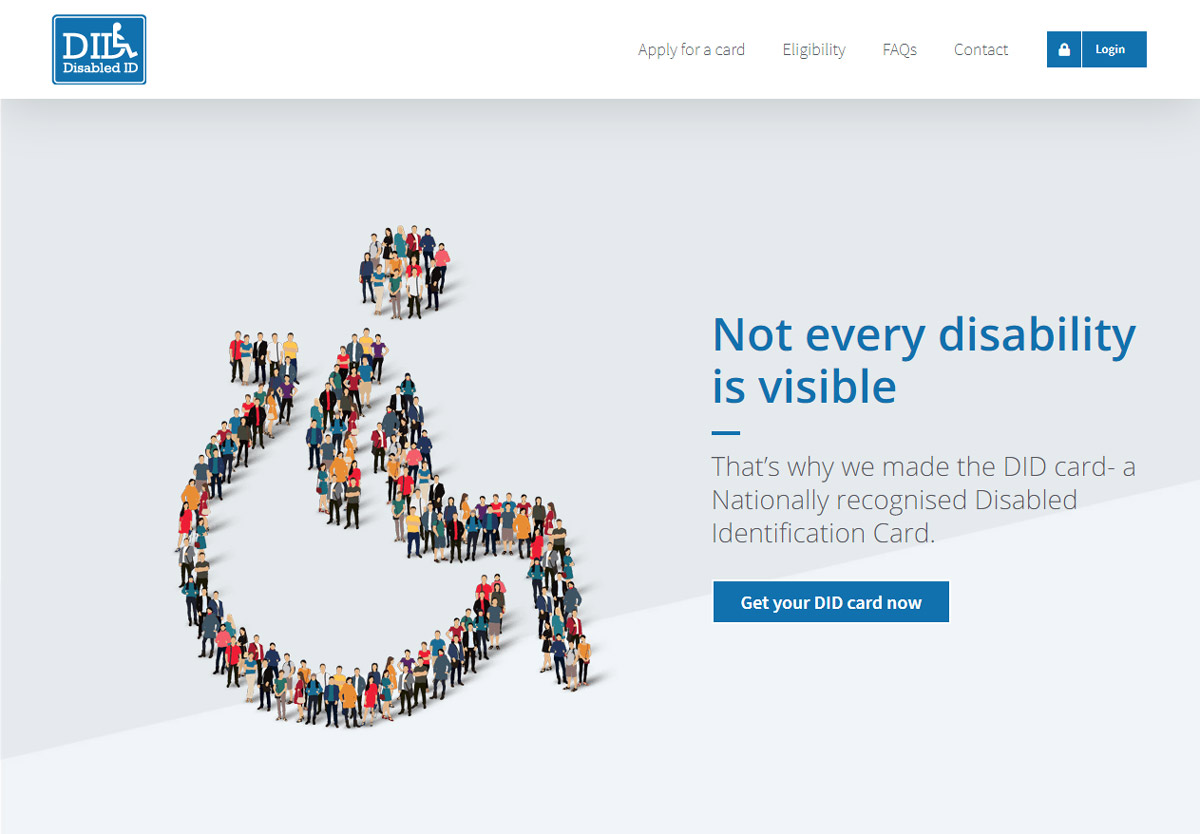
Infotex are excited to announce the website launch of DID Card, a local Woodbridge business that issues a National Disabled Identification Card for people to carry instead of their paperwork. The DID card is particularly aimed at individuals with disabilities that are not immediately obvious, and saves them having to carry their paperwork in order to prove they were entitled to some form of disability benefit and obtain a concessionary rate.
DID Card originally approached Infotex to build them a new website and help them with Facebook marketing and email automation. Despite some delays due to lockdown restrictions, their new FlexiPress website is now up and running. It provides all the information a client may need about the brand and service on offer, and directs traffic to their original card application site. We also worked with DID Card to create a database of Facebook ads for their independent use, and automated their renewal email process using Campaign Monitor.
To learn more about this wonderful company, visit the new website at
www.did-card.co.uk.
Adapting to changing markets is arguably most difficult for small businesses. Some, however, have managed to turn months of uncertainty into positive drives for their businesses, using online expertise to make the most of their services. Here are two examples of businesses we’ve worked with over the COVID period who turned hardship into survival stories so far.
Adapting to a new target market
London Gases sell gas for beer as a massive part of their business, so they took a hit when the pubs and hospitality sector closed in March.
But after upping their Pay-Per-Click spend to hit the Calor gas home consumer market, their PPC sales were up over 300%, and during the summer went up by around 600%. This meant that they were able to keep some of their delivery drivers on the road and in work over the last few months. We’ve kept their Google Shopping campaigns concentrated on those consumer-friendly gas sizes and products, and carefully managed budgets as demand increased.
If you can, write!
Stephens Scown’s website success increased when they posted articles relating to the furlough scheme in March. Organic traffic went up by 236% between February and March, a further 78% in April.
We worked with them to concentrate our search engine optimisation on coronavirus articles. Articles were continually adapted based on keywords that were gaining traction; for example, focusing more on the phrase ‘coronavirus’ than ‘covid’ (‘coronavirus’ was the more searched term at the time, though this is no longer the case).
They also updated their site so that we could update stories with changes to information that would then reflect in the article (and show: article updated on…), so that they could keep the information fresh and current. The types and themes of the articles that were being produced were tracked and categorised, so that each story could have a series of posts relating to it. For example, one particular item would have firstly an initial article, followed by ‘what we know so far’, a ‘key questions answered’ article a few days later, and then a piece around how it relates to a specific sector.
Due to the many legal questions that people needed answering during the height of the pandemic (furloughing, unfurlouging, child care arrangements for separated couples, divorce during covid, landlord and tenant issues, to name a few), Stephens Scown were in a good position to use their expertise to reach people who needed help understanding so many uncertainties, and create leads to their website.
Despite a second lockdown taking hold, there is still room for optimism. When properly thought through, online markets can be navigated to help you and your business adapt to a changing world.
If you have an e-commerce website, or utilize content marketing, Web Push Notifications could be the next step for you to keep re-engaging with your website visitors, allowing you to reach them on any device, without them needing to hand over any personal data.
We’re all familiar with regular push notifications: the banner notifications that come from the apps on your phone, such as a missed call, unread text notification, BBC news update, new match on Tinder. If you have enabled notifications for any app, that app is able to use the phones operating system to send you messages. Everyone with a smartphone knows how engaging these notifications are, grabbing your attention in real-time, with direct access to your screen no matter what you’re doing.
It is commonly believed that this type of customer-engagement marketing is limited to those who have a ‘native app’ (that is, an app that customers have to download onto their phone from the app store in order to access it’s features). However, with the efforts being made by Google and Apple to explore and move towards ‘progessive web apps’ (apps that you don’t need to download from a store, more like a website), more and more of the features of smartphone operating systems are available to improve and enhance your website or online marketing… without needing to develop a native app.
In the same way that when you install a native app on your smartphone your app asks the user for permission to access notifications features, your website can ask new visitors for approval to send them website push notifications. Once this ‘visitor’ has become a ‘subscriber’, you can then send them notifications from the website in the form of customised text, URL links, and images.
Web push notifications instantly offer some big improvements from other forms of notification marketing and native app notifications (e.g. newsletters, SMS).
You might now be wondering how to use push notifications in your marketing strategy. While the technology is not that new any more given it’s been used on every smartphone over the past 10 years, it’s introduction into a new medium (website) does mean that we can be a lot much more creative.
These are just a few of the more obvious ways to implement push notifications. But with the wealth of creative minds in our industry it is likely to be used in new and exciting ways. We have already created a push notification for a green lobbyist client, that allows them to send push notifications on their articles, but also send out real time smog warnings for affected cities or other urgent messages.
If you would like to talk more about push notifications and now it could improve your website marketing, please do not hesitate to get in touch.
Discover how our team can help you on your journey.
Talk to us today